 how-to
Is Speed and Agility Training Worth It for Youth Athletes?
Last Updated: October 26, 2026
Quick Summary
Speed and agility training for youth athletes is worth it because it builds acceleration, deceleration, coordination, and reaction time, and it lowers injury risk when coached correctly. Two to three focused sessions per week is the sweet spot for most young athletes, with at least one full rest day between hard sessions.
- Good youth drills mimic real games: quick starts, hard stops, sharp cuts, and fast reactions.
- Keep sets short with full rest of 60 to 90 seconds between short sprints.
- Ages 7 to 10 need 20 to 30 minute sessions twice per week focused on play.
- During a growth spurt, cut jumping and sprinting volume by roughly a third.
- Track a 10-yard sprint time and broad jump distance every four to six weeks.
Table of Contents
- What Speed and Agility Training Actually Does for Young Athletes
- Youth Speed and Agility Drills That Build Real Game Speed
- How Often Should Youth Athletes Train Speed and Agility?
- Agility Drills for Kids: Keeping It Safe and Age-Appropriate
- What a Good Youth Athlete Speed Training Program Includes
- Where Most Youth Speed Programs Fall Short
- Getting Your Young Athlete Started at ProFormance Sports
- Frequently Asked Questions
What Speed and Agility Training Actually Does for Young Athletes
Speed and agility training for youth athletes is a structured program of movement drills that builds acceleration, deceleration, coordination, and reaction time in children and teens. At ProFormance Sports, we build these programs around a simple truth: game speed is a skill, not a gift.
Here is what most parents get wrong. They assume speed is something a kid either has or doesn't.
The American Academy of Pediatrics guidance on youth sports stresses that young athletes benefit most from age-appropriate, well-supervised training that builds fundamental movement skills before sport-specific load.
Speed and agility training is the practice of teaching young athletes to sprint, cut, stop, and react with better mechanics and control.
Below, we break down what the drills should look like, how often to train, and where most youth programs fall short.
Youth Speed and Agility Drills That Build Real Game Speed
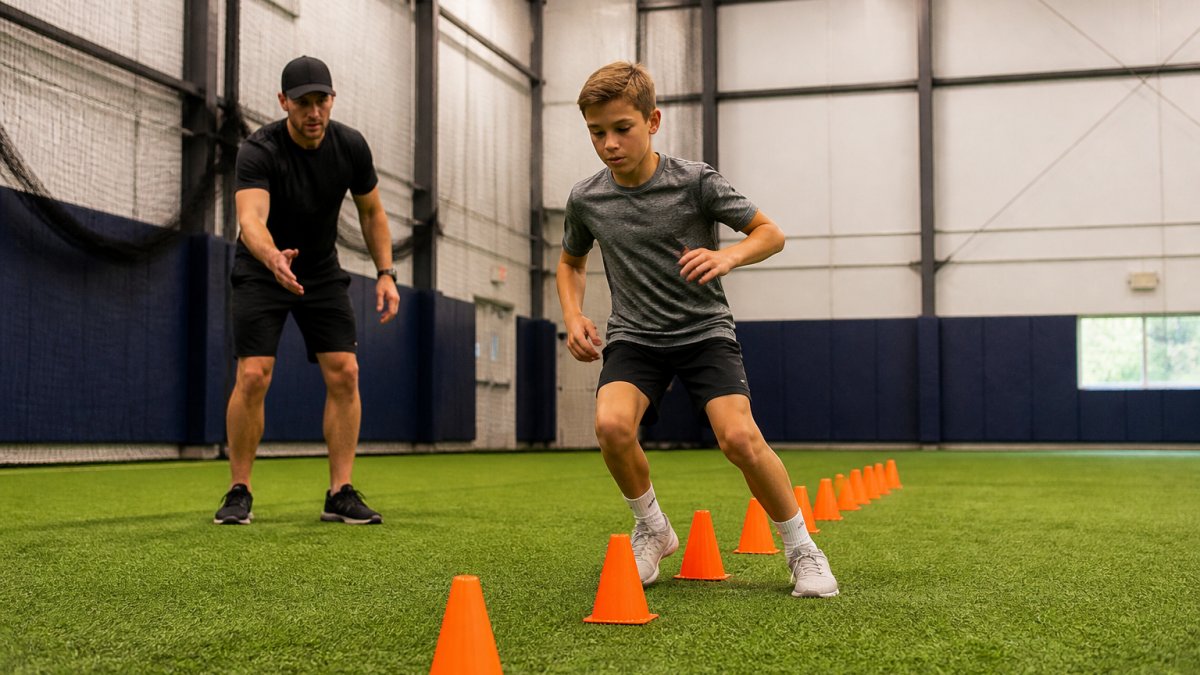
Good youth speed and agility drills mimic the chaos of a real game: quick starts, hard stops, sharp cuts, and fast reactions. Fancy equipment matters far less than clean movement mechanics.
We group the work into two buckets. Both matter, and neither should be skipped.
Acceleration and Deceleration Work
Acceleration is how fast an athlete gets to top speed. Deceleration is how well they stop and reset. Most programs chase the first and ignore the second. That is a mistake.
A common mistake is training sprints only. Young athletes who can explode forward but cannot brake safely are the ones who get hurt on a cut.
Try these:
- Short sprints from a two-point or three-point start, 10 to 20 meters
- Wall drills for sprint technique and stride frequency
- Cone drills that force a hard stop and a re-acceleration
- Lateral quickness shuffles with a controlled plant foot
Keep sets short and rest full. Speed work is about quality, not fatigue.
Jumping and Landing Mechanics
Plyometrics teach explosive power, but only if the landing is coached. A soft, quiet landing with bent knees and stacked hips is the goal.
Start with low-level jumps and build up. Depth drops from a low box, broad jumps, and single-leg hops all teach force production and control. Watch for knees caving in or loud, stiff landings.
How Often Should Youth Athletes Train Speed and Agility?
Two to three focused sessions per week is the sweet spot for most young athletes, with at least one full rest day between hard sessions. Quality beats quantity every time, a short, sharp session done well beats a long, sloppy one. The table below is a simple weekly frame that works alongside sport practice.
| Day | Focus | Duration | Notes |
|---|---|---|---|
| Monday | Acceleration and sprint technique | 30-40 min | Full rest between reps |
| Wednesday | Plyometrics and landing mechanics | 25-30 min | Low volume, high quality |
| Friday | Agility ladder and reaction drills | 30 min | Keep it fun and fast |
| Other days | Sport practice or active play | Varies | No added speed load |
The Recovery Rules That Actually Matter
Speed work is a nervous-system skill, not a fatigue test. That means full rest between reps, often 60 to 90 seconds for short sprints, and stopping a set when mechanics break down. Two hard speed days back-to-back is a recipe for sloppy movement and overuse complaints. Sleep and nutrition do more for a young athlete's speed than one extra drill ever will.
Growth Spurts: When to Pull Back
Rapid growth phases throw coordination off and raise injury risk at the growth plates. A teen who was smooth last season can look clumsy for a few months. That is normal and temporary. During a growth spurt, cut jumping and sprinting volume by roughly a third, prioritize landing mechanics and core stability, and add recovery days rather than removing them.
The Long Game: LTAD and Why Patience Pays
The long-term athletic development model treats youth training as a long game. Instead of chasing peak performance at 12, it builds a broad base of motor skills first, then layers in speed, strength, and sport-specific work as the athlete matures. This is one of the angles most programs miss. Patience now pays off in durability later, athletes who build a wide movement base as kids tend to stay healthier and progress further in their teens.
Agility Drills for Kids: Keeping It Safe and Age-Appropriate
Safety in youth agility work is not about doing less, it is about matching the drill to the developmental stage. A 9-year-old and a 15-year-old can both run a cone course, but the coaching cues, volume, and intent should look nothing alike. The framework below is the one most youth strength and conditioning practitioners use, and it maps to the long-term athletic development (LTAD) stages popularized by youth coaching bodies.
Ages 7 to 10: Play Is the Program
At this stage, the goal is broad motor-skill exposure, not sport-specific speed. Tag games, obstacle courses, mirror drills, and balance work build kinesthetic awareness and body control without the monotony of repeated sprints. Keep instructions to one or two cues per drill. Sessions of 20 to 30 minutes, two times per week, are plenty. If a kid is laughing and moving, the session is working.
Ages 11 to 14: The Skill-Acquisition Window
This is where coordination, sprint mechanics, and basic plyometrics take hold. Add agility ladder patterns, low-level jumps with coached landings, and short acceleration work from a two-point start. Watch for the coordination dip that arrives with early puberty, a kid who was smooth last season may look awkward for a few months. That is normal. Reduce complexity, not effort, and keep the focus on clean mechanics.
Ages 15 and Up: Structure and Load
Older teens can handle periodized programming, more intense conditioning, and sport-specific change-of-direction work. This is also when strength training can be layered in under qualified supervision. Volume can rise, but recovery has to rise with it.
The Warm-Up Is Not Optional
A proper warm-up primes the nervous system and lowers injury risk. A simple sequence works: five minutes of light movement to raise body temperature, dynamic mobility for hips and ankles, then two or three progressive build-up sprints at 60, 75, and 85 percent effort. Skipping this to save time is the fastest route to a pulled muscle.
The Cognitive Side Most Programs Ignore
Agility is not just physical, it is perceptual. The best youth programs train reaction and decision-making alongside mechanics. Simple additions: a partner points left or right and the athlete cuts on cue; a coach calls a color that maps to a direction; athletes mirror a partner's movement.
What a Good Youth Athlete Speed Training Program Includes
A solid youth athlete speed training program covers more than drills. It includes an assessment, a plan, and regular check-ins. It also respects the long-term athletic development model.
Here is what we look for:
- A movement screen to spot imbalances and hip mobility limits
- A warm-up that primes the nervous system
- Progressions that build from simple to complex
- Core stability and functional movement work
- Planned recovery and deload weeks
- Clear goals tracked over months, not days
Growth Spurts, Recovery, and the LTAD Model
Growth spurts throw coordination off. A teen who was smooth last season can look clumsy for a few months. That is normal, and it is temporary.
The long-term athletic development model treats youth training as a long game. Instead of chasing peak performance at 12, it builds a broad base of motor skills first. This is one of the angles most programs miss. Patience now pays off in durability later.
Where Most Youth Speed Programs Fall Short
Most youth speed programs are drill lists with no progression and no assessment. Kids run the same ladders and cones for months with no plan behind them. That is where progress stalls.
Two gaps stand out. First, psychological and cognitive development gets ignored. Second, home-based equipment alternatives rarely get mentioned.
In practice, the best programs blend movement mechanics, recovery protocols, and honest feedback. They also know when to refer a young athlete for a clinical look.
Getting Your Young Athlete Started at ProFormance Sports
The real question is not whether speed and agility training works. It is whether your young athlete is getting a plan built for their body, their age, and their sport.
At ProFormance Sports, our licensed physical therapists and sports performance team build personalized programs around each athlete.
If you want your child to move better and stay healthy, start with an assessment. Get started with ProFormance Sports and give your young athlete a program built to last.
Frequently Asked Questions
How often should youth athletes do speed and agility training?
Most young athletes do well with two to three speed and agility sessions per week, spaced at least 48 hours apart so the nervous system can recover. Sessions can run 30 to 45 minutes, with more time spent on quality reps than total volume. During a competitive season, cut back to one or two sessions and coordinate with the athlete's team schedule. A physical therapist or qualified coach can adjust frequency based on age, training age, and growth stage.
At what age can children start agility training?
Kids as young as 6 or 7 can start basic agility training through games that involve running, stopping, changing direction, and hopping. The focus at that age should be fun and fundamental movement, not structured speed work. Formal speed and agility training with measured sprints and plyometrics usually fits better around ages 10 to 12, once basic movement patterns are solid. Progressions should always match the child's stage of development, not just their birthday.
Can young athletes train speed and strength at the same time?
Yes. Combining speed work with age-appropriate strength training is common and generally supported when the total workload is managed. The key is sequencing: put speed and agility work early in a session when the athlete is fresh, then follow with strength work. Keep an eye on total training volume across school sports, club teams, and private sessions. A qualified professional can help balance the load and reduce injury risk during growth spurts.
What are the best speed and agility drills for young athletes?
Effective youth speed and agility drills include short accelerations of 10 to 20 yards, deceleration and stopping drills, cone weaving, lateral shuffles, and low-level plyometrics such as pogo hops and box jumps. Agility ladder work helps with foot speed and coordination, while reaction drills with a partner build neuromuscular coordination and change of direction. The best drill is one the athlete can perform with good mechanics at their current stage of development.
How should a youth athlete warm up before speed training?
A proper warm-up before speed training should take 10 to 15 minutes and move from general to specific. Start with light jogging or skipping to raise body temperature, then add dynamic stretches like leg swings, hip openers, and walking lunges to improve hip mobility. Finish with movement prep: skips, A-skips, lateral shuffles, and two or three progressive sprints at 70 to 80 percent effort. This sequence primes the nervous system and lowers injury risk during max-effort work.