 blog
Does Schroth Therapy Improve Scoliosis? What to Know
Last Updated: October 25, 2026
Quick Summary
Yes, Schroth therapy can improve scoliosis for many people, but with real limits. It does not straighten a spine like surgery does; instead it builds postural awareness, strengthens muscles around the curve, and helps some patients manage pain and function better.
- Schroth treats the curve in three dimensions using rotational breathing and muscle activation.
- Evidence is strongest for pain, function, and postural awareness, not for reversing large curves.
- A typical session includes assessment, corrective positioning, rotational breathing, and muscle activation drills.
- Most patients notice small posture changes within a few weeks of consistent practice.
- A home program of 15 to 30 minutes daily is the biggest predictor of results.
Table of Contents
- What the Schroth Method Is and How It Works
- Schroth Method Effectiveness: What the Evidence Shows
- Schroth Exercises for Scoliosis: What a Session Looks Like
- How Long Does Schroth Therapy Take to Work?
- How Schroth Compares With Bracing, Surgery, and Other Care
- Who Is Most Likely to Benefit, and Who Should Reassess
- Staying Consistent: Adherence, Home Programs, and Long-Term Outcomes
- Starting Schroth Therapy With a Licensed Physical Therapist
- Frequently Asked Questions
What the Schroth Method Is and How It Works
Does Schroth therapy improve scoliosis? At ProFormance Sports, our licensed physical therapists use it as part of a broader, personalized plan, never as a stand-alone cure.
Here is the honest version: Schroth therapy is one of the most studied forms of physiotherapeutic scoliosis-specific exercise, often shortened to PSSE. It does not straighten a spine like surgery does.
The method comes from Katharina Schroth, a German therapist who developed it in the early 1900s (The method of Katharina Schroth - history, principles and current development).
Three-Dimensional Correction and Rotational Breathing
A scoliosis curve is not just a side-to-side bend. The spine also rotates, and the rib cage twists with it.
The core tool is rotational breathing. Instead of breathing into the stiff side of the rib cage, a patient learns to direct air into the collapsed side.
Then comes muscle activation. The therapist cues specific muscles to hold that corrected position while the patient breathes and moves. Over time, the body learns a new default posture.
Schroth Method Effectiveness: What the Evidence Shows
The honest answer: evidence supports Schroth for some outcomes, and the quality of studies varies. Research on scoliosis-specific exercise generally points to benefits in pain, posture, and quality of life for many patients. It does not reliably reverse a curve.
Here is where the evidence gets murky. Many studies are small, and some lack control groups. That means results should be read with care, not treated as proof of a cure.
Where the Evidence Is Strongest and Where It Is Limited
The strongest support tends to be for:
- Pain and function in adults with scoliosis
- Postural awareness and body image in adolescents
- Slowing curve progression when combined with other care, especially in growing children
The limits matter too. Schroth is not shown to consistently reduce a large Cobb angle, the standard measure of curve severity. Skeletal maturity plays a big role: a child still growing has more potential to influence curve progression than an adult whose bones have finished forming.
Reading the Research Without Overreading It
Most published Schroth studies fall into a few recognizable designs, and knowing the design helps you judge the claim.
- Randomized controlled trials are the strongest design, but they are few and often small. A typical trial might enroll 30 to 50 adolescents and compare Schroth plus bracing against bracing alone over several months. Those studies can show a difference in Cobb angle or quality-of-life scores, but the sample is too small to prove a durable effect on progression.
- Prospective cohort studies follow one group over time without a control arm. They are useful for describing what happens in practice, but they cannot separate the therapy from growth, bracing, or natural history.
- Retrospective chart reviews look backward at patients who already completed treatment. They are prone to selection bias because the patients who stuck with a demanding program may differ from those who did not.
A common pattern in the literature is a modest short-term change in Cobb angle, often in the range of a few degrees, that is statistically significant in a small sample but of uncertain clinical importance. Pain and function scores tend to move more consistently than curve measurements. That is why a good therapist frames Schroth around function and posture rather than promising a straighter spine.
What the Certainty of Evidence Actually Means
Certainty of evidence is a formal rating, not a vibe. When a systematic review rates the certainty as low or very low, it usually means the studies were small, unblinded, inconsistent, or at high risk of bias.
A common mistake is expecting Schroth alone to "fix" a curve. In practice, it works best as one part of a conservative care plan, often alongside bracing or observation.
Schroth Exercises for Scoliosis: What a Session Looks Like
A Schroth session is not a generic gym workout. Every exercise is matched to your curve pattern, which is why a cookie-cutter home program rarely delivers the same result.
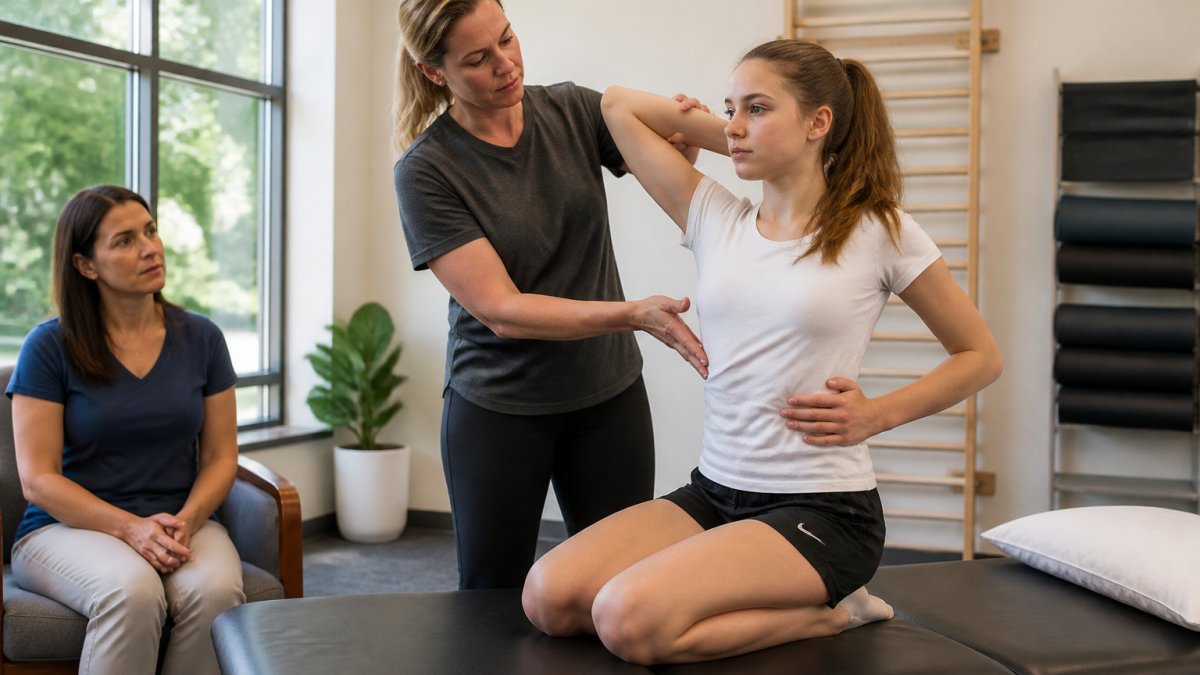
A typical session includes:
- Assessment: the therapist reviews your X-rays and checks spinal flexibility and posture
- Corrective positioning: you learn to find your "corrected" posture using mirrors and cues
- Rotational breathing: you practice breathing into the collapsed side of the rib cage
- Muscle activation drills: you hold the corrected position while activating specific muscles
- Home practice: you leave with a short daily routine to reinforce the work
The exercises look small and precise. That is the point. Precision beats intensity here.
How Long Does Schroth Therapy Take to Work?
Most patients notice small changes in posture and body awareness within a few weeks of consistent practice. Curve-related goals take longer and depend on age, curve size, and how faithfully you practice. (Source: the National Institute of Arthritis and Musculoskeletal and Skin Diseases (NIAMS))
How long does Schroth therapy take overall? There is no single timeline. A common approach is supervised sessions once or twice a week, plus a daily home program of 15 to 30 minutes. Some patients continue for months.
The variable that matters most is exercise adherence. Schroth rewards consistency. Skipping home practice is the fastest way to stall progress.
How Schroth Compares With Bracing, Surgery, and Other Care
Schroth is one option among several, and comparing them honestly helps you choose well. The table below is a starting point, but the right choice depends on age, curve size, growth status, symptoms, and what you are trying to achieve.
| Approach | What It Does | Best For | Main Limit |
|---|---|---|---|
| Schroth therapy | Retrains posture, breathing, and muscle control | Mild to moderate curves, pain, posture goals | Does not reliably reduce large curves |
| Bracing | Holds the curve while a child grows | Growing children with moderate curves | Needs many hours of daily wear |
| Surgery | Fuses part of the spine to correct a curve | Severe, progressing curves | Major procedure with real risks |
| General PT | Builds strength and mobility | Pain and general function | Not curve-specific |
Schroth and bracing often work together. A child who wears a brace can use Schroth to stay active and hold posture when the brace is off. Surgery is usually reserved for severe, progressing curves, and Schroth is not a substitute for it.
Comparing by Age, Curve Severity, and Goal
The same curve can call for different plans depending on who is being treated and what they want.
Growing children and adolescents. In a skeletally immature patient with a moderate curve, the priority is usually preventing progression.
Adults. Once growth is finished, the goal shifts from preventing progression to managing pain, function, and posture. Schroth and general physical therapy both have a role here.
Severe or rapidly progressing curves. These belong in a medical or surgical evaluation first.
A Simple Decision Framework
Ask three questions in order:
- Is the curve still growing? If yes, progression risk drives the plan, and bracing plus monitoring usually comes first.
- How large is the curve? Mild to moderate curves are the sweet spot for conservative care. Large curves need medical evaluation.
- What is the goal? Pain and posture goals are realistic for Schroth. Curve reversal is not.
Best for: patients with mild to moderate curves who want a non-operative, active approach. Skip if: you have a severe, rapidly progressing curve that needs medical or surgical evaluation first.
Who Is Most Likely to Benefit, and Who Should Reassess
Adolescents with adolescent idiopathic scoliosis who are still growing often respond well, especially when Schroth is started early. Adults with adult scoliosis and chronic back pain frequently report better posture and pain management.
Who should reassess? Anyone whose curve is progressing quickly, whose pain is worsening, or who sees no change after a reasonable trial.
Watch out: pushing through sharp pain to "correct" a curve can make things worse. Correction should feel controlled, not forced.
Staying Consistent: Adherence, Home Programs, and Long-Term Outcomes
The biggest predictor of results is not the clinic. It is what you do between visits. A home exercise program of 15 to 30 minutes a day keeps the corrected posture fresh in your nervous system.
Practical ways to stay consistent:
- Pair practice with a fixed daily habit, like brushing teeth
- Keep a simple log of sessions and how you felt
- Film yourself occasionally to check posture
- Schedule a check-in with your therapist every few weeks
- Adjust the program as your curve and strength change
Long-term, Schroth is best viewed as a self-management skill. Patients who keep practicing tend to hold their gains better than those who stop once symptoms ease.
Starting Schroth Therapy With a Licensed Physical Therapist
Schroth is only as good as the therapist delivering it. Look for a licensed physical therapist with specific training in the Schroth Method and experience with your curve type.
At ProFormance Sports, our licensed physical therapists are trained in the Schroth Method for idiopathic scoliosis.
Questions worth asking any provider: How many Schroth patients have you treated? How do you measure progress? What does the home program look like? A good therapist welcomes these.
Frequently Asked Questions
Can Schroth therapy reduce a scoliosis curve?
Schroth therapy is not a cure, and it does not reliably reverse an established curve. Research on Schroth method effectiveness suggests some patients see modest curve reduction, often measured in a few degrees of Cobb angle, while others mainly gain better posture, less pain, and improved function. Results depend on curve type, skeletal maturity, and how consistently the program is followed. A physical therapist trained in the method can set realistic goals after an assessment.
How long does it take for Schroth therapy to work?
Most patients notice changes in posture and body awareness within a few weeks of supervised sessions, but measurable changes typically take longer. A common structure is several weeks of frequent visits to learn the exercises, followed by a home program practiced most days. How long does Schroth therapy take to show results varies with curve severity, age, and adherence, so ask your therapist for a reassessment point rather than judging progress week to week.
Is Schroth therapy a replacement for bracing or surgery?
No. Schroth therapy is a form of conservative care that is often used alongside bracing, not instead of it. For growing adolescents with moderate curves, a physician may recommend bracing, and Schroth exercises can support posture and comfort during that time. Surgery remains an option for curves that progress despite other care. Decisions about bracing or surgery should come from your physician, with therapy as one part of the plan.
Is Schroth therapy effective for adults with scoliosis?
Adults often seek Schroth therapy for back pain, postural fatigue, and mobility rather than curve correction. The approach focuses on muscle activation, core strength, and postural awareness, which can improve how you move and feel day to day. Adults with a stable curve and pain related to posture tend to respond well. Anyone with new or worsening pain, neurological symptoms, or rapid change should be evaluated by a physician first.
Scoliosis care is not one-size-fits-all, and the right plan depends on your curve, your age, and your goals. ProFormance Sports offers concierge physical therapy with Schroth-trained therapists, personalized treatment plans, and flexible scheduling to fit your routine. Get started with ProFormance Sports and build a plan that supports your spine for the long run.