 blog
Sports Performance Training: A Complete Guide
Table of Contents
- What Sports Performance Training Actually Includes
- Sports Performance Training Benefits for Athletes at Every Level
- Speed and Agility Training for Young Athletes
- Building a Youth Athlete Training Program That Fits Their Age
- Athletic Performance Training for Teens: What Changes After Puberty
- A Sample Training Week and How Progress Gets Measured
- Injury Prevention, Recovery, and Workload Management
- Frequently Asked Questions
Last Updated: October 19, 2026
What Sports Performance Training Actually Includes
Sports performance training is a planned system of exercise that builds the speed, strength, power, and agility an athlete needs to compete, and it is built around that athlete's sport, age, and movement quality. At ProFormance Sports, we treat it as a screening-and-coaching process, not a workout list. That distinction matters.
A common mistake is copying a workout from a teammate or a video. The training may look fine and still miss what your body needs. A real program starts with a movement assessment.
The Core Pillars: Speed, Strength, Power, and Agility
Four qualities carry most of the load in athletic performance:
- Speed: how fast you can accelerate and hold a sprint
- Strength: how much force your muscles can produce
- Power: how quickly you can apply that force
- Agility: how well you change direction without losing balance
Each pillar supports the others. Weak hips limit sprint speed. Poor landing mechanics limit power work. Train them together, with a plan.
How It Differs From Regular Strength Training
Regular strength training builds muscle and general fitness. Sports performance training ties every lift and drill to a sport skill.
A squat in the gym is general strength. A split squat with a reactive jump, timed to a whistle, trains strength for a sport. The National Strength and Conditioning Association frames this as training that transfers to competition, not just to a weight room PR.
Sports Performance Training Benefits for Athletes at Every Level
The clearest benefit is fewer avoidable injuries and better movement under fatigue. Many athletes also find that their speed and confidence improve once weak links are addressed.
Here is what a well-built program tends to deliver:
- Better sprinting and acceleration mechanics
- Stronger landing and cutting positions
- More consistent performance across a season
- Clear data on strengths and weaknesses
- A training plan that matches the athlete's age
The benefit is not automatic. It comes from consistent work and honest measurement.
Speed and Agility Training for Young Athletes
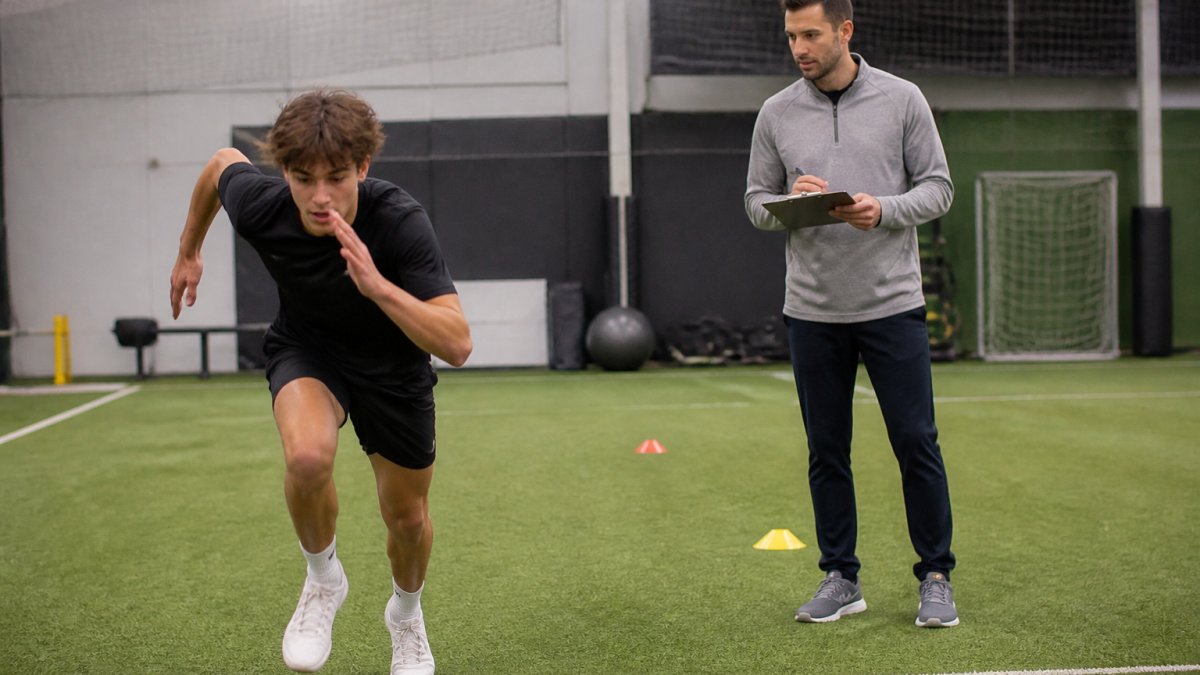
Speed and agility training for young athletes works best when it is short, frequent, and focused on clean movement rather than heavy loads. Young bodies adapt fast to coordination work, so quality beats volume.
Sprinting Mechanics and Acceleration Drills
Good sprinting starts with posture. We coach a tall chest, relaxed shoulders, and a strong forward lean on the first steps.
Drills we use:
- Wall marches to groove knee drive
- A-skips for rhythm and posture
- Falling starts for a clean first step
- Short accelerations over 10 to 20 meters
Keep reps short and rest fully. Sloppy reps teach sloppy habits.
Change of Direction and Movement Quality
Cutting and stopping put heavy load on knees and ankles. Teach athletes to sink their hips, keep knees over toes, and land quietly.
A simple progression:
- Deceleration runs, learning to stop under control
- Cone cuts at half speed, then full speed
- Reactive drills where the athlete reads a cue
Building a Youth Athlete Training Program That Fits Their Age
A youth athlete training program should match the athlete's stage of growth, not their ambition. Younger kids need movement variety and play. Older kids can handle more structure.
A simple guide by age:
- Ages 7 to 10: running, jumping, skipping, and bodyweight control
- Ages 11 to 13: basic strength with light resistance, plus coordination work
- Ages 14 to 17: structured strength and power work with close coaching
The American Academy of Pediatrics advises against early specialization and heavy competitive load in young athletes. Variety and recovery protect long-term health.
Athletic Performance Training for Teens: What Changes After Puberty
Athletic performance training for teens changes once puberty hits. Growth spurts shift limb length, balance, and coordination, so athletes often feel clumsy for a stretch.
What we adjust:
- More focus on landing and joint control during growth spurts
- Lighter loads while coordination catches up
- Extra attention to sleep and recovery
- Sport-specific work only after the basics are solid
Teens can train hard, but the plan has to respect growth. Pushing max loads during a spurt raises injury risk without adding much speed.
A Sample Training Week and How Progress Gets Measured
A sample week should balance hard days with recovery and leave room for sport practice. The table below is a template, not a prescription, the actual exercises, sets, and reps get adjusted to the athlete's assessment results, sport calendar, and training age.
| Day | Focus | Duration | Example Session |
|---|---|---|---|
| Monday | Speed and power | 45 min | Dynamic warm-up; 4 x 10 m falling starts; 3 x 20 m accelerations at 90%; 3 x 3 box jumps; 2 x 5 med-ball throws |
| Tuesday | Strength (lower) | 45 min | Trap-bar deadlift 3 x 5 at moderate load; split squat 3 x 8 per leg; Nordic curl 3 x 5; plank series |
| Wednesday | Recovery | 30 min | Mobility flow, easy bike or walk, breathing drills |
| Thursday | Agility and change of direction | 40 min | Deceleration runs; 4 x 5 cone cuts at 75% then 90%; 3 x reactive mirror drill; landing mechanics |
| Friday | Strength (upper) and power | 45 min | Push-up or bench variation 3 x 6; row 3 x 8; overhead press 3 x 6; 3 x 3 broad jumps |
| Saturday | Sport practice | Varies | Skill work and team session |
| Sunday | Rest | Full day | Sleep and recovery |
Three rules keep the template honest. First, keep at least 48 hours between hard speed and hard strength sessions for the same muscle groups. Second, never place a maximal speed or power day the day before a game or competition.
Baseline Testing and Performance Data
Progress needs a starting point. Test before training begins, repeat the same tests every four to six weeks, and retest under the same conditions (same surface, same time of day, same warm-up) so the numbers are comparable.
Tests we use and how to read them:
- 10 m and 20 m sprint: measures acceleration and top-end speed. A 10 m split tells you about the first-step drive; the 20 m split shows whether speed holds. Compare against the athlete's own baseline, not a generic chart.
- Vertical jump (countermovement jump): a proxy for lower-body power. A drop of more than about 10% from an athlete's baseline often signals fatigue and is a reason to back off load.
- Broad jump: measures horizontal power and landing control. Watch the landing as closely as the distance.
- 5-10-5 shuttle or T-test: measures change-of-direction ability. Record both time and whether the athlete stays low and controlled through the cuts.
- Movement screen: a short screen of squat, hinge, lunge, and overhead reach flags asymmetries and mobility limits before they become injuries.
Interpret baselines in context. The American College of Sports Medicine recommends baseline assessment before exercise so programs are built on real data rather than guesswork.
Injury Prevention, Recovery, and Workload Management
Injury prevention comes down to three habits: good mechanics, sensible workload, and real recovery. Skip any one and risk climbs. Most competitors stop at that sentence, here is what the habits actually look like in practice.
Warm-Up That Prepares, Not Just Stretches
A useful warm-up raises tissue temperature, rehearses the movements of the day, and primes the nervous system. A simple structure:
- General pulse-raiser (3-5 min): jog, bike, or jump rope
- Dynamic mobility (3-4 min): leg swings, hip openers, ankle rocks, thoracic rotations
- Activation (3-4 min): glute bridges, banded walks, dead bugs
- Potentiation (2-3 min): two or three progressive jumps or short accelerations at 70-80% effort
Static stretching held for long periods before speed or power work is a poor use of warm-up time, save it for cooldowns.
Workload Management: The Acute-to-Chronic Ratio
A practical way to catch risky spikes is to compare this week's training load to the athlete's recent average. A common approach among practitioners is the acute-to-chronic workload ratio: divide the last week's load (acute) by the rolling four-week average (chronic). A ratio well above roughly 1.3 to 1.5 has been associated with elevated injury risk in team-sport research, while a ratio below about 0.8 may mean the athlete is detraining.
What we watch:
- Sudden jumps in weekly volume, the classic cause of overuse injuries
- Too many hard days in a row without a lighter day between them
- Poor sleep and high school stress, which lower the load an athlete can absorb
- Pain that lingers past a few days, especially in one spot
Recovery That Actually Moves the Needle
Recovery is training too. Sleep, food, and light movement days let the body adapt. The highest-yield habits, in order:
- Sleep: most adolescent athletes need roughly 8-10 hours. Consistent bed and wake times matter as much as total hours.
- Fuel: protein at each meal, carbohydrates around hard sessions, and enough total calories to support growth and training.
- Light movement: easy walking, cycling, or mobility work on recovery days promotes blood flow without adding fatigue.
- Deload weeks: every fourth or fifth week, drop volume by roughly 30-40% while keeping some intensity so fitness holds.
When an athlete reports pain, we screen it early rather than push through. Our licensed physical therapists can assess movement and build a plan around it, which is where concierge care helps.
Frequently Asked Questions
At what age can a young athlete start performance training?
Most children can begin age-appropriate sports performance training around 7 to 9 years old, focusing on bodyweight movements, balance, and running mechanics rather than loaded strength work. A youth athlete training program should be built around movement quality and fun at that stage. Structured strength and power work with external load usually fits better once an athlete has consistent form and has gone through puberty. A movement assessment with a qualified coach or physical therapist will tell you whether your child is ready for more.
How is sports performance training different from regular strength training?
Regular strength training builds general muscle and lifting numbers. Sports performance training ties every lift and drill back to how you move on the field, court, or track. That means sprinting mechanics, change of direction, explosive power, and sport-specific training built around your performance goals. A good program starts with a movement assessment, identifies strengths and weaknesses, then programs around both. The result is athletic ability that transfers to competition, not just a bigger squat.
Can sports performance training help reduce injury risk?
It can help, especially when the program includes movement assessment, strength work for weak links, and workload management. Coaches and physical therapists often find that athletes who train consistently with good movement mechanics handle practice and game volume better. No program removes injury risk entirely, and that is worth saying plainly. The realistic goal is better movement quality, appropriate conditioning, and recovery habits that lower the odds of overuse problems.
How do you measure progress in a sports performance program?
Start with baseline testing: sprint times over 10 and 40 yards, vertical jump, a change of direction test, and a movement screen. Retest every 6 to 12 weeks and compare performance data against that baseline. Video review of running mechanics and lifting form adds context that raw numbers miss. Progress should show up in those tests and in how the athlete feels during competition. If nothing moves after a full training block, the program needs adjusting.
Athletes who train without a plan often repeat the same weak patterns for years. We built ProFormance Sports to fix that with movement assessments, InBody and Fit 3D scans, and one-on-one coaching from licensed physical therapists. Our team designs each program around the athlete's sport, age, and goals. Get started with ProFormance Sports and train with a plan that actually fits you.