 blog
Is One-on-One Sports Physical Therapy Worth It?
Last Updated: October 29, 2026
Quick Summary
One-on-one sports physical therapy is worth it when you are an athlete chasing a return date, a patient whose rehab has stalled, or someone with a complex history that generic protocols keep missing. A straightforward ankle sprain in a motivated patient often resolves well in a standard clinic, so match the care model to the complexity of the case.
- In a one-on-one model, the licensed therapist watches every rep and can adjust the plan mid-session.
- A dedicated session typically runs 45-60 minutes, versus 15-30 minutes of hands-on time in a shared clinic.
- Return-to-sport testing measures strength, range of motion, and movement quality against sport-specific benchmarks.
- Insurance plans may limit visits per year, require a physician referral, or deny coverage for performance goals.
- Confirm the therapist's license, patients per session, session length, and costs in writing before booking.
Table of Contents
- What One-on-One Sports Physical Therapy Actually Means
- The One-on-One Physical Therapy Benefits That Show Up in Outcomes
- Sports Injury Rehabilitation Built Around Your Sport
- Return to Sport Physical Therapy: Clearing You for Competition
- Physical Therapy Session Length and What Fills the Hour
- Costs, Insurance, and What Concierge Care Really Runs
- How to Choose a Sports Physical Therapist
- Book a Movement Assessment With ProFormance Sports
- Frequently Asked Questions
What One-on-One Sports Physical Therapy Actually Means
One-on-one sports physical therapy is a care model where a single licensed physical therapist works with one patient for the session, rather than sharing attention across several patients. Dedicated attention can change what a session accomplishes.
The distinction sounds minor until you see it in practice. In a shared-session clinic, a therapist may divide attention among several patients at once. A dedicated session is designed so the therapist's attention stays on one patient for the full appointment.

How a Dedicated Session Differs From a Shared Clinic Model
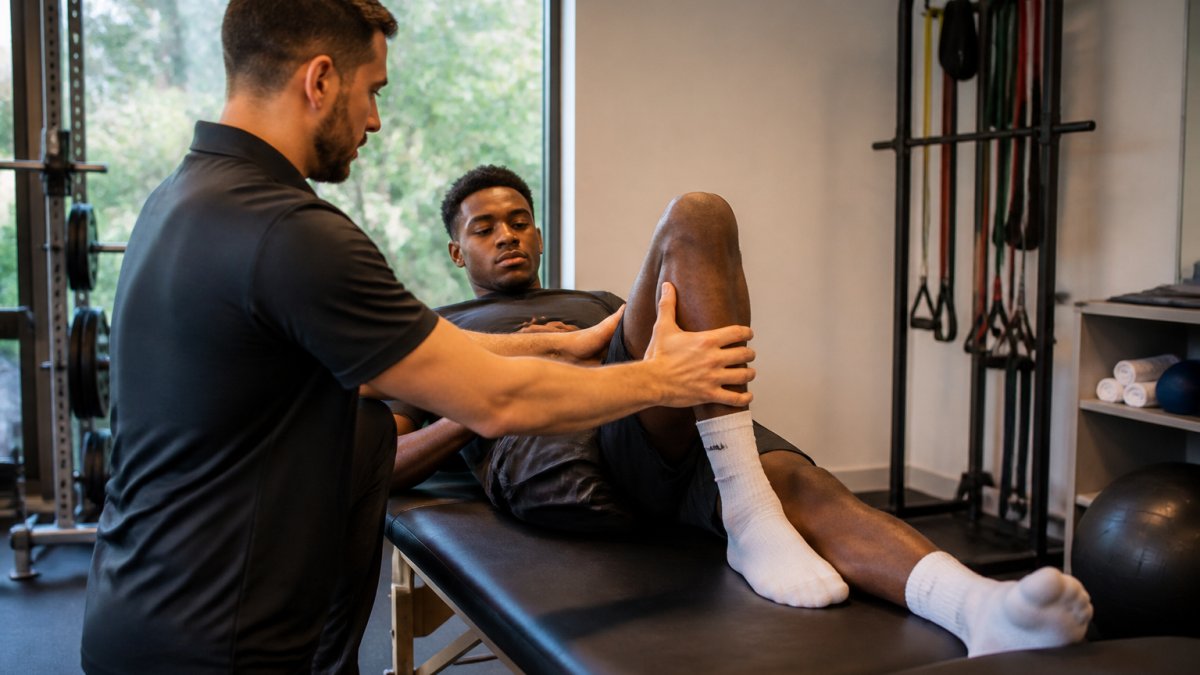
In a shared clinic model, the therapist divides attention across multiple patients. That means your exercise corrections come in passing, and your manual therapy may stop the moment another patient needs help. In a one-on-one model, the therapist watches every rep, adjusts load in real time, and can change the plan mid-session based on how your body responds.
The practical difference shows up in small moments. A therapist working one-on-one notices that your knee drifts inward on the third set of squats and fixes it before it becomes a habit. In a crowded clinic, that same flaw often goes uncorrected because no one is watching closely enough.
The One-on-One Physical Therapy Benefits That Show Up in Outcomes
A one-on-one model can support closer movement observation, timely skill correction, and treatment plans adjusted to the individual. When a therapist observes each repetition, errors may be caught early. But the benefits only make sense next to the alternative, so here is the comparison most clinic pages skip.
One-on-One vs. Shared-Session Care, Side by Side
| Dimension | Shared clinic model | One-on-one model |
|---|---|---|
| Therapist attention per visit | Often 15-30 minutes of direct hands-on time, with aides supervising exercise | The full session, typically 45-60 minutes |
| Who corrects your form | Whoever is free, often an aide | The licensed therapist, every rep |
| Continuity | Rotating therapists and aides are common | Same therapist across the plan of care |
| Plan adjustments | Weekly or at re-evaluation | Mid-session, based on how you respond |
| Cost per visit | Lower sticker price, often in-network | Higher sticker price, often self-pay or out-of-network |
| Best fit | Simple, uncomplicated cases | Athletes, complex histories, stalled rehab |
The trade-off goes in both directions. A shared clinic can be a reasonable choice for a straightforward ankle sprain in a motivated patient. Dedicated care may come with a different cost structure and network status, so confirm those details directly with the provider. The value of one-on-one care lies in therapist time and the ability to adjust the plan during the session, which can matter most when the diagnosis is unclear or the return date is fixed.
How Progress Gets Measured, Not Just Described
Patients often describe valuing focused attention. Rehab generally depends on appropriate dosing: too little load may not drive tissue adaptation, and too much may aggravate symptoms. A therapist who knows a patient's full history can adjust that balance session by session.
Progress can also be made visible by tracking repeatable measures at set points in a plan of care:
No single number proves you are ready, and no ethical provider promises a guaranteed timeline. What the measures do is turn a vague "you're getting better" into a trend line you and your therapist can both see. Ask any provider which measures they use and how often they re-test; a clinic that thinks in benchmarks will answer quickly, and one that thinks in generalities will not.
Continuity of Care and Why the Same Therapist Matters
Seeing the same therapist across visits can help build a continuous record of how a patient moves and responds to exercise, which can make each session a step forward rather than a restart.
In settings where therapists rotate, patients may need to re-explain their history, and subtle changes can be lost. A one-on-one model can reduce that friction for patients.
Sports Injury Rehabilitation Built Around Your Sport
Sports injury rehabilitation is often most effective when it mirrors the demands of the athlete's sport, rather than relying on a generic exercise sheet. A soccer player needs cutting, deceleration, and single-leg control. A swimmer needs shoulder endurance and overhead mobility.
Movement analysis can inform that customization. A therapist may observe how a patient runs, lands, squats, and rotates, then consider which weak links an exercise program should address. For example, a recurring hamstring strain may relate to hip control under fatigue rather than hamstring strength alone.
A common rehab mistake is returning to full training as soon as pain fades. Pain relief is not the same as tissue readiness, and returning too early can increase the risk of re-injury.
Return to Sport Physical Therapy: Clearing You for Competition
Return to sport physical therapy is the final phase of rehab, where the goal shifts from reducing pain to proving you can handle competition-level loads. Clearing an athlete typically involves testing strength, range of motion, and movement quality against sport-specific benchmarks, not only asking how the injury feels.
A sound return-to-play progression moves through stages: full pain-free range of motion, symmetrical strength, tolerated sport-specific drills, then controlled contact or high-speed work. Each stage has exit criteria.
Progress tracking can make those decisions more objective. Repeatable tests taken at consistent points in recovery can show whether a gap is closing or whether progress reflects a single good week.
Physical Therapy Session Length and What Fills the Hour
Physical therapy session length varies by provider and care model. A session may include assessment, hands-on treatment, and supervised exercise, with the balance shifting as a patient progresses.
Here is how a dedicated session tends to break down:
Session duration alone does not guarantee quality, but it can set a practical ceiling on what is possible within a visit.
Costs, Insurance, and What Concierge Care Really Runs
Concierge physical therapy may cost more per visit than standard clinic care, and insurance coverage varies by plan. Most clinic pages stop there. This section gives you the mechanics so you can actually compare offers instead of guessing.
What Drives the Price of a One-on-One Visit
Pricing for physical therapy can depend on several factors, including the type of visit, session length, provider credentials, any add-on services, and whether visits are purchased individually or as a package. ProFormance Sports does not publish pricing in this article; please check the website or request a quote for current prices.
Rates vary by provider, so this article does not quote a number. Ask any provider for the evaluation price, follow-up visit price, expected number of visits, and total estimated out-of-pocket cost in writing.
How Insurance Actually Interacts With One-on-One Care
Insurance plans commonly limit therapy in ways that may affect concierge care:
- Visit caps: many plans allow a set number of visits per year or per condition, and a longer plan of care can exhaust them
- Referral requirements: some plans require a physician referral before therapy is covered
- Network status: a provider may be out-of-network, which can affect reimbursement and patient responsibility
- Medical necessity review: coverage often depends on documented functional deficits, and performance or prevention goals may not be covered
The Centers for Medicare & Medicaid Services publishes guidance on therapy coverage that helps you read your own benefits, and your insurer can confirm out-of-network rates and any visit cap in writing before you commit. Ask for the explanation of benefits language, not a verbal summary.
How to Choose a Sports Physical Therapist
Choosing a sports physical therapist comes down to five checks: credentials, care model, sports experience, measurement, and fit. Run every candidate through this list before you book.
- Confirm the therapist's license and any relevant credentials
- Ask how many patients the therapist treats during a session
- Ask about experience with athletes in your sport and the return-to-sport testing they use
- Request the objective measures they track
- Confirm session length, who you will see each visit, and whether the same therapist stays with you
- Get the cost in writing, including what insurance covers and what you will pay out of pocket
The care model matters as much as the therapist's skill. A therapist managing several patients at once may have less attention available per patient, and the care model can shape which treatment approaches are practical.
The American Physical Therapy Association maintains resources on specialist certification that help you verify credentials, and asking directly about return-to-sport testing tells you quickly whether a provider thinks in benchmarks or in generalities.
If you are weighing whether one-on-one sports physical therapy is worth it, the honest limitation is this: not everyone needs it. A straightforward ankle sprain in a motivated patient often resolves well in a standard clinic.
Book a Movement Assessment With ProFormance Sports
The gap between a generic rehab plan and one built around your sport usually shows up in the first assessment. ProFormance Sports provides concierge physical therapy and sports performance training with a multidisciplinary team of licensed physical therapists, speech and language pathologists, and massage therapists, delivering personalized treatment plans.
ProFormance Sports's team includes licensed physical therapists, speech and language pathologists, and massage therapists, and our physical therapists are trained in the Schroth Method for idiopathic scoliosis. We use InBody and Fit 3D scans, and offer flexible scheduling options.
If your rehab has plateaued or you want to understand injury risk, consider starting with a movement assessment. Get started with ProFormance Sports to discuss a plan built around your movement.
Frequently Asked Questions
How is one-on-one physical therapy different from group therapy?
In a one-on-one session, a single licensed physical therapist works with one patient rather than sharing attention across several. Group or shared-session models divide the therapist's attention among multiple patients. That difference matters most for sports physical therapy, where small changes in movement quality are the whole point. Ask any clinic directly how many patients your therapist treats at once before you book.
How long does a sports physical therapy session last?
Session length varies by clinic and by care model. Ask any provider how long a session runs and whether that time is hands-on treatment or includes other activities such as paperwork. Ask about physical therapy session length when you call, and confirm whether the quoted time is hands-on treatment or includes ice, heat, and paperwork.
Can sports physical therapy help prevent injuries?
It can reduce risk, though no program removes it entirely. A physical therapist may use movement analysis and functional assessment to look for asymmetries, weak ranges of motion, and mechanics that could relate to injury risk. From there, an exercise program can target those gaps. Injury prevention works best as an ongoing partnership rather than a one-time screening, especially for athletes training year-round.
How do I choose a sports physical therapist?
Look for a licensed physical therapist with experience treating your specific sport. Ask whether they hold a specialist credential, how long sessions run, and whether you see the same therapist every visit. Confirm what hands-on treatment and progress tracking they provide. A therapist who asks about your competition calendar and treatment goals before recommending an approach may be a good sign.