 how-to
Are Personalized Treatment Plans Worth It for Recovery?
Last Updated: November 5, 2026
Quick Summary
Personalized treatment plans for maximum recovery in rehabilitation are built around your specific injury, movement patterns, and goals, then adjusted as you progress. Each plan starts with baseline testing and movement assessment, sets goals beyond pain relief, and uses regular re-testing so progress is measured rather than guessed.
- A personalized treatment plan has three parts: a full assessment, clear goals, and regular re-testing.
- Baseline testing with InBody and Fit 3D scans measures range of motion, strength, and movement as your starting line.
- Phase 1 ACL exercises include quad sets, straight-leg raises, heel slides, and ankle pumps.
- Phase 1 ends when you meet measurable criteria, not when a set number of days passes.
- Return to sport after ACL surgery should be decided by criteria, not a fixed date.
Table of Contents
- Why Standard Rehab Protocols Fall Short for Real Recovery
- What a Personalized Treatment Plan for Rehabilitation Actually Includes
- ACL Rehabilitation Protocol: Matching Each Phase to Your Body
- ACL Rehab Exercises Phase 1: What to Do in the First Weeks
- ACL Strengthening Exercises That Rebuild Knee Stability
- Return to Sport After ACL Surgery: Criteria, Not Calendars
- Tracking Progress and Knowing When to Adjust the Plan
- Getting Started With a Plan Built Around You
- Frequently Asked Questions
Why Standard Rehab Protocols Fall Short for Real Recovery
Standard rehab protocols can miss something important: no two knees, shoulders, or timelines are alike. Personalized treatment plans for maximum recovery for rehabilitation start with the person, not the handout. At ProFormance Sports, we build each plan around baseline testing and real goals. A generic plan can leave you doing exercises that are too easy, too hard, or aimed at the wrong problem. Curious how rehab timelines actually get estimated? Read our guide on how to estimate sports injury rehab time.
What a Personalized Treatment Plan for Rehabilitation Actually Includes
A personalized treatment plan is a rehab program built around your specific injury, movement patterns, and goals, adjusted as you progress. It is not a generic exercise sheet. It has three parts: a full assessment, clear goals, and regular re-testing.
Baseline Testing and Movement Assessment
Your plan starts with measurement. We test range of motion, strength, and how you move. Our technology, including InBody and Fit 3D scans, helps measure your body's movement and composition. These numbers become your starting line. Without them, progress is just a guess.
Goal Setting That Goes Beyond Pain Relief
Pain relief is the floor, not the ceiling. We ask what you want to get back to: a sport, a hike, picking up your kids. Those goals shape every phase of the plan. Wondering whether this level of attention is worth it? See our breakdown of whether one-on-one sports physical therapy is worth it.
ACL Rehabilitation Protocol: Matching Each Phase to Your Body
An ACL rehabilitation protocol is a phased plan that guides you from early healing through strength work to return to sport. The phases are standard. The pace is not. Your body decides how fast you move through them.
Early Phase Priorities: Swelling, Quadriceps Activation, and Range of Motion
The first weeks generally focus on swelling management, quadriceps activation, and restoring flexion and extension.
Graft Integration and the Mid-Stage Transition
Graft integration is the process where the new ligament matures and bonds with the bone. It takes months, not weeks. During this stage, loading is typically increased gradually while watching for swelling, since pushing too fast can be a common mistake.
ACL Rehab Exercises Phase 1: What to Do in the First Weeks
Phase 1 exercises are generally gentle and focused on controlling swelling, restoring extension, and reactivating the quadriceps. The pace is typically set by your surgeon's post-operative protocol and how your knee responds.
Expect a short daily menu rather than a long workout. Typical Phase 1 exercises include:
- Quad sets: tighten the thigh muscle by pressing the back of the knee down toward the floor or a rolled towel; hold 5-10 seconds, 10-15 reps, several times daily.
- Straight-leg raises: with the knee locked straight, lift the leg 12-18 inches and lower slowly; 2-3 sets of 10-15 reps.
- Heel slides: slide the heel toward the buttock to restore flexion, holding a gentle stretch at the end range; 10-15 reps, a few times daily.
- Ankle pumps: point and flex the ankle to help circulation and swelling; 20-30 reps every hour or two while awake.
- Patellar mobilizations: gentle side-to-side and up-down glides of the kneecap, usually performed by your therapist early on to prevent scar-tissue restriction.
- Terminal knee extensions and mini squats: added once quad control returns, often in the second or third week.
Your weight-bearing status is determined based on your surgeon's post-operative protocol.
Watch out: pushing range of motion or loading too aggressively in the first weeks can irritate the graft and increase swelling, which slows the very healing you are trying to speed up.
Home Environment Modifications for the Crutch-Dependent Phase
Most return-to-sport guides skip the practical reality of the first few weeks: you are navigating a house on crutches with a swollen knee. A few low-cost changes make Phase 1 safer and easier to comply with.
- Clear a straight path between the bed, bathroom, and a comfortable chair; remove loose rugs and cords.
- Set up a recovery station with ice, a compression wrap, a water bottle, medications, phone charger, and a notebook for exercise logs within arm's reach.
- Put a sturdy chair in the bathroom and consider a shower chair and raised toilet seat for the non-weight-bearing window.
- Pre-cook or stock easy meals and move frequently used kitchen items to counter height so you are not carrying things while on crutches.
- Keep a small cooler or ice pack rotation by the couch, since icing several times daily is easier when it is not a trip to the freezer.
These adjustments are not clinical care, but they directly affect how often you actually do your exercises and how much you move safely between sessions, both of which feed into the progression criteria your therapist uses to advance you.
Criteria for Advancing Out of Phase 1
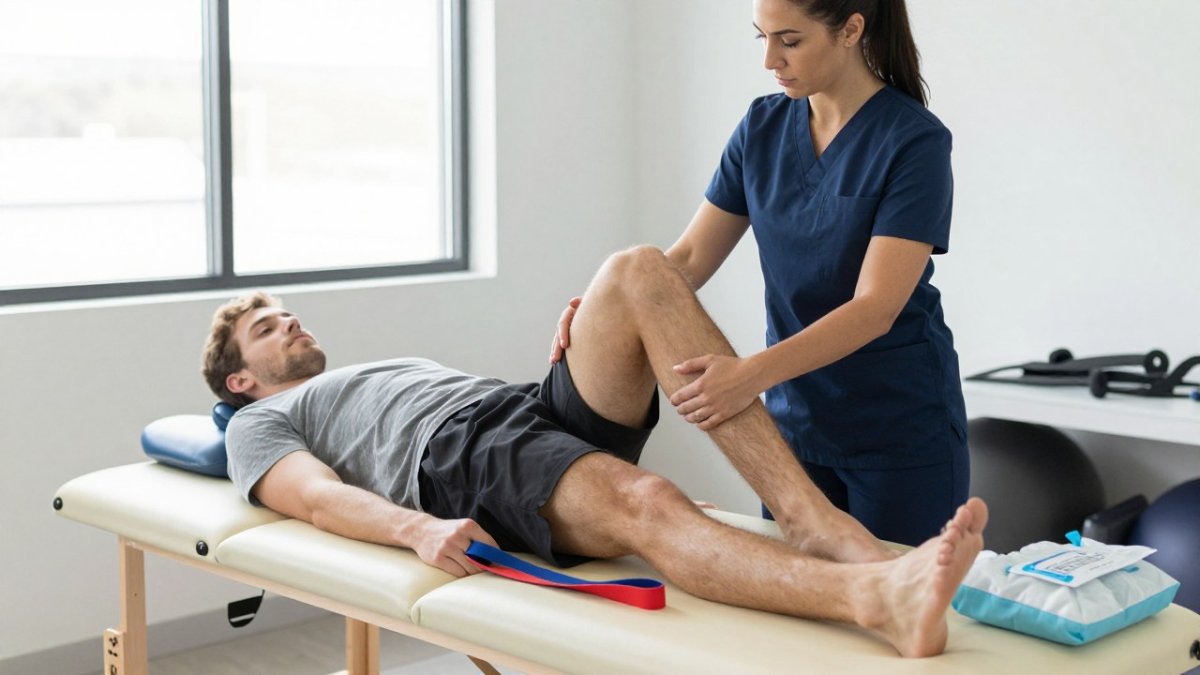
Phase 1 ends when you meet measurable criteria, not when a set number of days passes. Commonly referenced benchmarks include minimal joint swelling, near-full passive knee extension, good quadriceps control, and the ability to perform straight-leg raises without a lag. Your therapist can advise which criteria apply to you.
Phase 1 keeps the daily menu short, with each exercise aimed at swelling, extension, or quad control.
| Exercise | How to do it | Dose |
|---|---|---|
| Quad sets | Press back of knee toward floor or rolled towel | Hold 5-10 seconds, 10-15 reps, several times daily |
| Straight-leg raises | Knee locked straight, lift leg 12-18 inches, lower slowly | 2-3 sets of 10-15 reps |
| Heel slides | Slide heel toward buttock, hold gentle stretch at end range | 10-15 reps, a few times daily |
| Ankle pumps | Point and flex the ankle for circulation and swelling | 20-30 reps every hour or two while awake |
| Patellar mobilizations | Gentle side-to-side and up-down kneecap glides | Usually performed by your therapist early on |
| Terminal knee extensions and mini squats | Added once quad control returns | Often in the second or third week |
ACL Strengthening Exercises That Rebuild Knee Stability
Strength work rebuilds knee stability by loading the muscles around the joint in a controlled way. This is where the kinetic chain matters. Weak hips or ankles put extra stress on the knee.
Closed Kinetic Chain and Eccentric Loading Progressions
Closed kinetic chain exercises, like squats and leg presses, keep the foot planted. Eccentric loading, the slow lowering phase, builds tendon and muscle tolerance. We progress these based on how your knee responds, not a calendar.
Return to Sport After ACL Surgery: Criteria, Not Calendars
Return to sport after ACL surgery should be decided by criteria, not a fixed date (Return To Sport Following ACL Reconstruction). Returning to sport is generally best guided by passing a set of tests rather than reaching a specific time point.
Psychological Readiness and Functional Testing
Functional testing checks strength, hopping, and movement quality side to side. But physical tests miss fear and confidence. Psychological readiness surveys help us spot athletes who are physically cleared but not mentally ready. Both matter. For a broader look at what individualized care involves, see our guide on choosing the right sports physical therapy clinic.
Tracking Progress and Knowing When to Adjust the Plan
Progress tracking turns rehab from guesswork into data. We re-test range of motion, strength, and swelling at set points. If the numbers stall, we change the plan. Some people find apps or wearables helpful for logging activity between visits. Either way, the plan stays flexible. That flexibility is the whole point of personalized treatment plans.
Getting Started With a Plan Built Around You
Rehab works best when the plan fits your body, your sport, and your life. If you are ready to find care, our guide on sports physical therapy near me walks you through what to ask and compare.
Frequently Asked Questions
What should a personalized rehabilitation plan include?
A personalized treatment plan for rehabilitation starts with a baseline assessment: range of motion, strength, joint effusion, gait mechanics, and functional testing. From there, your therapist sets goals specific to your sport, activity level, and daily demands. The plan should list the rehabilitation phases you will move through, the therapeutic exercise prescribed at each stage, weight-bearing status, and the criteria you must meet before progressing. It also builds in scheduled re-testing so the plan changes as your knee stability and neuromuscular control improve, rather than following a fixed calendar.
How often should an ACL rehabilitation protocol be updated?
Plans are typically reviewed periodically in the early stages, then less often as you progress. The trigger for updating is not the calendar but your measurements. If quadriceps activation, range of motion, or swelling management is not where it should be, the plan needs to change. Warning signs include persistent joint effusion, a plateau in flexion and extension, or pain that increases with loading. Your therapist should re-run functional testing and adjust exercises before you move to the next rehabilitation phase.
When can an athlete return to sport after ACL surgery?
Return to sport after ACL surgery depends on passing criteria, not a set number of months. Common considerations include range of motion, quadriceps strength, neuromuscular control, and functional testing such as hop tests and agility drills. Your physical therapist can advise which criteria apply to you. Ligament maturation and graft integration continue well beyond the early months, so pushing back too soon raises re-injury risk. Psychological readiness matters too. Your physical therapist should clear you based on measured knee stability and sport-specific movement, not just time since surgery.
How do physical therapists measure progress during rehabilitation?
Physical therapists measure progress with objective tools: goniometry for flexion and extension, handheld dynamometry for quadriceps strength, hop tests and agility drills for functional testing, and questionnaires for psychological readiness. Tracking apps and wearables can log step counts, loading, and home exercise consistency between visits. Technology such as InBody and Fit 3D scans can add body composition and movement data to the assessment process.
Your recovery should not follow someone else's timeline. At ProFormance Sports, our licensed physical therapists build personalized treatment plans using InBody and Fit 3D scans, flexible scheduling, and a team that includes massage therapists and speech and language pathologists. We track your progress and adjust as your body responds. Get started with ProFormance Sports and build a recovery plan made for you.