 how-to
How to Estimate Sports Injury Rehab Time
Last Updated: November 2, 2026
Quick Summary
Sports injury rehab takes anywhere from days to 12 months or more, depending on injury severity, the tissue damaged, and how your body responds. Mild injuries often resolve in days to a few weeks, moderate injuries need several weeks of structured rehab, and severe injuries such as an ACL rupture can take 6-12 months.
- Rehab moves through four overlapping stages, each with its own goals and objective exit criteria.
- Start rehab early, often within days of injury, once serious damage is ruled out.
- Return to sport should be based on functional criteria, not a calendar date.
- A safe return progresses from no-contact practice to full game participation with 24-hour checks.
- If symptoms return, ease off, review your rehab consistency, and get reassessed.
Table of Contents
- What Determines How Long Sports Injury Rehab Takes
- Sports Injury Recovery Timeline: What to Expect by Injury Type
- The Sports Injury Rehabilitation Stages
- When to Start Rehab After a Sports Injury
- Return to Sport After Injury: Objective Criteria, Not Just Time
- What to Do When Recovery Stalls or Symptoms Return
- Building Your Personalized Rehab Plan with ProFormance Sports
- Frequently Asked Questions
What Determines How Long Sports Injury Rehab Takes
Sports injury rehab is the structured process of restoring movement, strength, and function after an athletic injury, and it rarely follows a single fixed schedule. Most athletes want a number, but the honest answer is a range. That range depends on what tissue was damaged, how badly, and how your body responds to treatment.
Time alone tells you almost nothing about readiness. A mild ankle sprain and a surgically repaired knee can both be "six weeks out," but only one athlete is actually ready to compete.
Injury Severity: Mild, Moderate, and Severe
Severity is the biggest driver of recovery time. A mild injury involves minor tissue damage with little loss of function. A moderate injury limits activity and needs guided care. A severe injury, such as a full ligament tear, often means surgery and months of work.
- Mild: days to a few weeks of reduced activity
- Moderate: several weeks of structured rehab
- Severe: months, sometimes longer with surgery
Individual Factors That Change Timelines
Two athletes with the same diagnosis can recover on very different schedules. Age, baseline strength, sleep, nutrition, and how consistently someone shows up for rehab all shift the timeline. A prior injury in the same area also slows things down.
Pain tolerance matters too, but not in the way people think. Pushing through sharp pain tends to set recovery back, not speed it up.
Sports Injury Recovery Timeline: What to Expect by Injury Type
The sports injury recovery timeline varies widely by injury type and severity. Use the ranges below as a general guide, not a promise. Your clinical assessment will refine them.
| Injury Type | Typical Range | Key Note |
|---|---|---|
| Muscle strain | 1-6 weeks | Mild strains heal fast; severe tears take longer |
| Sprain | 2-8 weeks | Depends on which ligament and grade |
| Contusion (bruise) | Days to 3 weeks | Usually resolves with rest and ice |
| Ligament tear | 6 weeks to several months | May need surgery |
| ACL rupture | 6-12 months | Reconstruction adds rehab time |
A mild injury often resolves with rest and basic movement. A moderate injury needs a rehab program. A severe injury, especially an ACL rupture, involves a long return-to-sport path. These are estimates, and your provider will give you a clearer picture after an exam.
The Sports Injury Rehabilitation Stages
Rehabilitation moves through four overlapping stages, not three, and each has a clear goal, a typical time window, and objective exit criteria. Skipping ahead is the most common mistake we see. Tissue needs time to heal before it can handle load, and each stage earns the next one.
The windows below assume a moderate injury in a healthy athlete. Mild injuries compress them; severe or surgical injuries stretch them. Treat the weeks as checkpoints, not deadlines.
Phase 1: Protect and Calm the Injury (Days 0-7)
The first phase calms the injury. The goals are simple: control pain, reduce swelling, and protect the tissue while keeping it active enough to avoid stiffness. Common steps include relative rest, ice, compression, elevation, and gentle movement as tolerated.
- Keep pain during activity at a mild level
- Move the joint through a pain-free range several times a day
- Avoid complete immobilization unless a clinician directs it
Watch out: complete bed rest for too long can stiffen a joint and slow recovery. Gentle, guided movement usually helps more than doing nothing.
Exit criteria: swelling trending down, pain controlled with light activity, and near-full pain-free range of motion.
Phase 2: Restore Movement and Strength (Weeks 1-6)
Once pain and swelling settle, the focus shifts to mobility and strength. This is where a rehab program earns its keep. You rebuild range of motion first, then add resistance work to bring back strength.
A common progression looks like this:
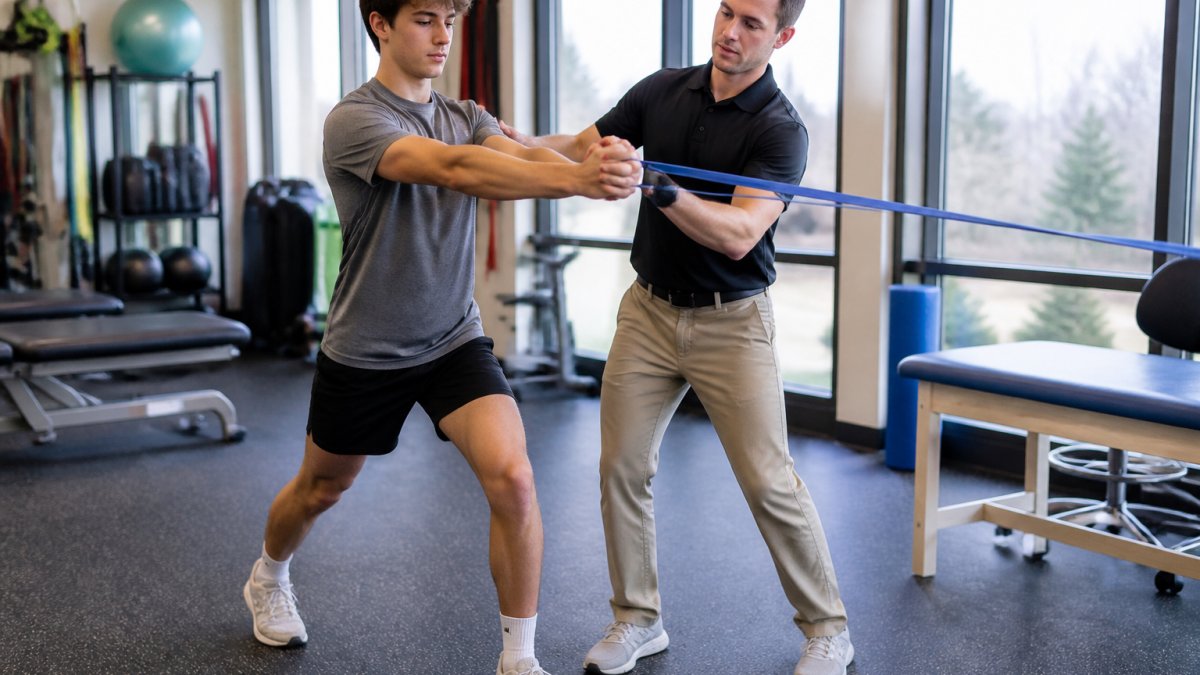
- Weeks 1-2: full range-of-motion work, isometric holds, and low-load band exercises
- Weeks 3-4: controlled strengthening through the full range, single-leg balance, and light plyometrics if the joint tolerates them
- Weeks 5-6: heavier resistance, eccentric loading, and beginning sport-specific movement patterns
Track progress with objective measures where possible, such as grip strength or range-of-motion numbers. If you want a step-by-step walkthrough of this phase, see our guide on 7 steps to sports injury physical therapy for teens.
Exit criteria: strength within about 10% of the uninjured side, full pain-free range of motion, and no swelling after activity.
Phase 3: Rebuild Power and Sport-Specific Skills (Weeks 4-12)
This phase bridges rehab and competition. You add sprinting, cutting, jumping, and skills work in a controlled progression. The goal is to teach the tissue to handle the demands of your sport, not just to feel better.
- Start with straight-line running, then add curves and cuts
- Add jumping and landing drills before full-speed sprinting
- Introduce sport-specific drills at partial speed, then build to full speed
Reinjury risk drops when athletes complete this phase fully instead of rushing back. For a deeper look at building performance safely, read our complete guide to sports performance training.
Exit criteria: passing functional tests, confidence during sport-specific movement, and no pain or swelling the day after training.
Phase 4: Return to Sport and Prevent Reinjury (Weeks 8 and Beyond)
The final phase is the transition back to full competition. It includes a graded return, often starting with limited practice minutes and building over several weeks. The goal is to prevent reinjury, not just to clear the athlete.
- Progress practice time before game time
- Monitor soreness and swelling for 24 hours after each session
- Keep a maintenance strength program going after return
When to Start Rehab After a Sports Injury
Rehab should start early, often within days of the injury, once serious damage is ruled out. Early rehab does not mean hard training. It means guided movement that protects the tissue while keeping it active.
Delaying care is a common mistake. Swelling that lingers, pain that worsens, or a joint that won't bear weight are signs to get seen. If you're deciding where to begin, our guide on sports physical therapy near me walks through how to choose care.
Return to Sport After Injury: Objective Criteria, Not Just Time
Return to sport after injury should be based on functional criteria, not a calendar. Time passing does not mean tissue is ready. Clinicians use a battery of objective tests to confirm readiness, and the athlete should pass each gate before advancing.
A practical framework uses four gates:
- Gate 1: Pain and swelling. No pain with sport-specific movement and no swelling the day after training.
- Gate 2: Strength. Strength close to the uninjured side on a reliable test.
- Gate 3: Functional tests. Passing hop, jump, and agility tests.
- Gate 4: Sport-specific confidence. The athlete completes full-speed drills and feels confident, not guarded, during cutting and contact.
A clinical assessment ties these together. The American Academy of Orthopaedic Surgeons offers patient guidance on injury recovery and safe activity. Movement quality matters as much as raw strength, which is why we measure both.
What the Tests Actually Look Like
Clinicians commonly use a small set of reliable tests rather than a single number:
- Single-leg hop for distance: compares the injured and uninjured legs
- Triple hop and crossover hop: tests power and control
- Agility T-test or modified shuttle: tests change of direction
- Single-leg balance and landing mechanics: tests control under load
Some sports, especially those with cutting and contact, use stricter thresholds.
The Graded Return-to-Play Progression
Clearing the tests is not the same as being ready for a full game. A safe progression usually moves through these steps:
- Full practice with no contact
- Full practice with controlled contact
- Limited game minutes
- Full game participation
Each step should be followed by a 24-hour check for soreness or swelling before moving to the next. If symptoms return, step back one level rather than pushing through.
Watch out: an athlete who passes tests in the clinic but has not practiced at full speed is still at risk. The progression, not the test score alone, is what protects the athlete.
What to Do When Recovery Stalls or Symptoms Return
A stalled recovery is common, and it usually has a cause. Symptoms that return can mean the load was increased too fast, a phase was skipped, or something else is going on.
Start by reviewing your rehab consistency and load. If pain or swelling comes back, ease off and get reassessed. Do not ignore a setback and push harder.
- Recheck sleep, nutrition, and stress
- Confirm you completed each phase fully
- Ask for a fresh clinical assessment
The National Institute of Arthritis and Musculoskeletal and Skin Diseases explains how soft tissue heals, which helps you understand why setbacks happen. A qualified provider can adjust your plan when progress flattens.
Building Your Personalized Rehab Plan with ProFormance Sports
A personalized plan beats a generic one because it matches your injury, your sport, and your body. At ProFormance Sports, our licensed physical therapists build rehab around your specific situation. We use tools like InBody and Fit 3D scans to help track progress.
ProFormance Sports offers concierge physical therapy, so you can expect personalized attention from a licensed therapist. That matters if past PT felt like going through the motions. If you're weighing that approach, read is one-on-one sports physical therapy worth it. Ready to choose a clinic? See our guidance on choosing the right sports physical therapy clinic.
Frequently Asked Questions
Which sports injury takes the longest to heal?
ACL ruptures and other severe ligament tears typically take the longest. After ACL reconstruction, return to sport often takes 9 to 12 months or more, depending on the individual. Severe tendon ruptures and complex fractures can also require extended rehab. Recovery time depends on injury severity, treatment, and consistent rehabilitation, so a clinical assessment is essential for an accurate timeline.
What are the 5 stages of rehabilitation in sport?
Most sports injury rehabilitation stages include: 1) pain and swelling control, 2) restoring range of motion, 3) rebuilding strength, 4) sport-specific training, and 5) return to sport and prevention. Some models add a preliminary stage of injury protection or a final stage of ongoing maintenance. Each stage has functional criteria you should meet before progressing, and a physical therapist can help you move through them safely.
How long after injury should you start rehab?
For many mild injuries, you can start gentle movement and rehab within a few days, once acute pain and swelling begin to settle. More severe injuries or those requiring surgery may need a short period of protection first. The key is to begin when it is safe, not to wait until you feel completely pain-free. A physical therapist can assess your injury and tell you exactly when to start rehab after a sports injury.
Can you speed up sports injury recovery?
You cannot rush tissue healing, but you can optimize the conditions for it. Consistent adherence to your rehabilitation program, adequate sleep, proper nutrition, and avoiding overtraining all support faster recovery. Working with a physical therapist who tailors your plan and monitors progress helps you avoid setbacks. Remember that pushing too hard can prolong recovery and increase reinjury risk, so follow your clinician's guidance.
Recovering from a sports injury takes patience and the right plan. If you want a rehab program built around your goals, our team can help. ProFormance Sports offers concierge physical therapy, objective progress tracking with InBody and Fit 3D scans, and flexible scheduling that fits your life. Get started with ProFormance Sports and move back toward the sport you love with a plan made for you.