 how-to
How to Improve Athletic Performance at Every Level
Last Updated: October 30, 2026
Quick Summary
To improve athletic performance, stop training generically and build a seven-step plan around your sport: set measurable benchmarks, build strength, add speed and agility work, raise work capacity with intervals and cross-training, fuel with sports nutrition, prioritize recovery beyond sleep, and periodize your load while tracking progress monthly. Each step builds on the last, so skipping one weakens the others.
- Test five qualities in week one: speed, power, strength, endurance, and mobility, keeping every test repeatable.
- Master bodyweight patterns before adding load, and leave a rep or two in reserve on most sets.
- Stop a speed drill the moment form breaks, because speed work done tired trains slowness.
- Use a 1:2 work-to-rest ratio as a simple interval template and log each result.
- Watch for soreness that lingers, a creeping resting heart rate, or performance drops across several sessions.
Table of Contents
- How to Improve Athletic Performance: Build a Plan Around Your Sport
- Step 1: Set Measurable Benchmarks Before You Train
- Step 2: Build Strength Training for Young Athletes and Adults
- Step 3: Add Speed and Agility Training for Athletes
- Step 4: Use Interval Training and Cross-Training to Raise Work Capacity
- Step 5: Apply Sports Nutrition for Athletes
- Step 6: Prioritize Athletic Performance Recovery Beyond Sleep
- Step 7: Periodize Your Load and Track Progress Each Month
- Frequently Asked Questions
How to Improve Athletic Performance: Build a Plan Around Your Sport
Learning how to improve athletic performance starts with one shift: stop training generically and start training for your sport. Athletes often train hard but train for the wrong things.
Athletic performance is your ability to execute the skills your sport demands, at speed, under fatigue, without breaking down.
Below, we break down a seven-step plan you can actually follow. Each step builds on the last. Skip one and the others lose power.
Step 1: Set Measurable Benchmarks Before You Train
You cannot improve what you never measure. Before your first workout, test the qualities your sport rewards. A sprinter might time a 10-meter start. A volleyball player might measure vertical jump.
Here is what to record in week one:
- Speed: a timed sprint over a fixed distance
- Power: a vertical or broad jump
- Strength: a rep max on a core lift, done safely
- Endurance: a timed effort at a set pace
- Mobility: a simple screen of hips, ankles, and shoulders
Keep the tests repeatable. Same surface, same shoes, same time of day. The American College of Sports Medicine stresses baseline testing before program design, and that logic holds for any athlete.
Record these five qualities in week one, keeping every test repeatable.
| Quality | What to record |
|---|---|
| Speed | A timed sprint over a fixed distance |
| Power | A vertical or broad jump |
| Strength | A rep max on a core lift, done safely |
| Endurance | A timed effort at a set pace |
| Mobility | A simple screen of hips, ankles, and shoulders |
Step 2: Build Strength Training for Young Athletes and Adults
Strength is the base every other quality sits on. For young athletes, focus on bodyweight control, movement quality, and light loads with perfect form. For adults, progressive loading builds the force you convert into speed and power.
A common mistake is chasing heavy numbers before earning clean movement.
Practical rules that work at any age:
- Master bodyweight patterns before adding load
- Train the whole body, not just the sport's favorite muscles
- Add load slowly, one variable at a time
- Leave a rep or two in reserve on most sets
Strength training for young athletes should build confidence, not burnout. Consistency beats intensity here.
Step 3: Add Speed and Agility Training for Athletes
Speed and agility training for athletes trains the nervous system to move fast and react faster. That means short bursts, full recovery, and sharp cues, not long grinding sets.
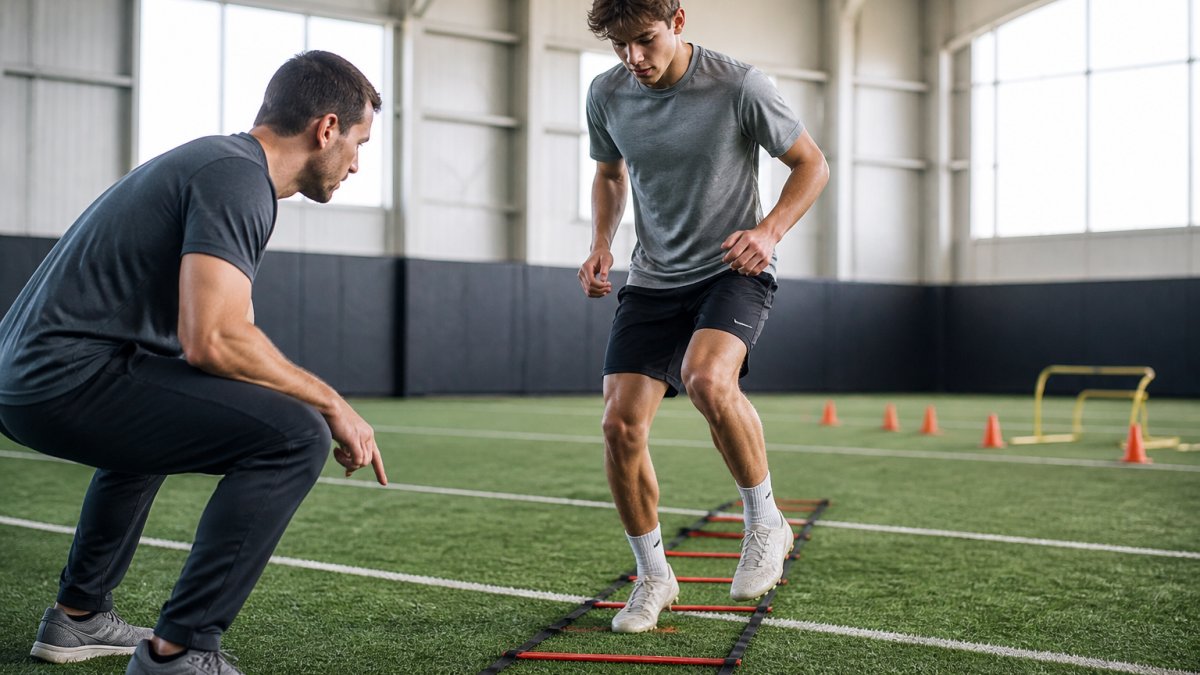
Start with the basics:
- Ladder drills for foot speed and rhythm
- Cone drills for cutting and change of direction
- Sprint work over short distances with full rest
Quality matters more than volume. If you are unsure whether this training is worth the time for a young athlete, read our breakdown on whether speed and agility training is worth it for youth athletes.
Step 4: Use Interval Training and Cross-Training to Raise Work Capacity
Work capacity is how much hard work you can absorb and still perform. Interval training builds it fast: short efforts with planned rest. Cross-training adds variety and spares your joints from repeat strain.
A simple interval template:
- Pick a modality: bike, rower, or running
- Work hard for a set time
- Rest at a fixed ratio, such as 1:2
- Repeat for a set number of rounds
- Cool down and log the result
Cross-training with swimming, cycling, or rowing keeps fitness high while reducing pounding. The CDC physical activity guidance supports mixing aerobic, strength, and mobility work across the week. Variety is not a distraction. It is insurance.
Step 5: Apply Sports Nutrition for Athletes
Sports nutrition for athletes fuels the work you do. You cannot out-train poor fuel. But generic advice like "eat clean" does not tell you what to put on the plate before a hard session or how much to drink when it is 90 degrees.
Build plates around whole foods: fruits, vegetables, lean meats, eggs, whole grains, and nuts. Then adjust the timing and amount around your training.
Carbohydrates: Your Main Energy Source
Carbohydrates are the body's preferred fuel for hard training. Muscle glycogen, the stored form of carbohydrate, is what powers sprints, intervals, and late-game efforts. When glycogen runs low, power drops and perceived effort climbs.
General carbohydrate timing guidance is a common starting point for athletes; a qualified professional can tailor it to you:
You do not need to weigh food. A banana, a slice of bread with jam, or a sports drink can each cover a snack-sized dose. The point is to stop training fasted by accident.
Protein for Repair
Protein supports muscle repair and adaptation. Protein is commonly spread across the day rather than crammed into one meal. Eggs, Greek yogurt, chicken, fish, and legumes all work.
Hydration and Fluid Balance
Hydration affects focus, power, and how you feel late in a game. Drink to thirst as a baseline, and add more in heat or during long sessions. A simple check: pale yellow urine suggests adequate hydration; dark yellow suggests you are behind. For sessions over an hour in the heat, an electrolyte drink helps replace sodium lost in sweat.
Supplements: Check the Evidence and the Label
Supplements deserve caution. Many supplement products make claims that go beyond the available evidence. Before you add anything:
- Ask whether a whole-food fix would do the same job
- Look for third-party testing seals, which indicate a product was screened for contaminants and banned substances
- Check the label against FDA supplement information
- Treat bold claims and proprietary blends as red flags
Food first is a sound general principle.
Step 6: Prioritize Athletic Performance Recovery Beyond Sleep
Athletic performance recovery is more than eight hours in bed, though sleep is the anchor. Recovery is the whole set of habits that let your body adapt to training instead of breaking down. Most competitors stop at "get sleep and stretch." The practical gap is knowing what a real rest day looks like, how to use active recovery, and how to tell when your body is not keeping up.
Sleep: The Anchor
A consistent schedule and a dark, cool room do more than any gadget. Aim for a regular bedtime and wake time, and treat sleep as part of training, not a reward for it.
Rest Days and Active Recovery
A rest day is not another hard workout in disguise. Real rest means low load: a walk, easy mobility, or nothing at all. Active recovery, such as easy cycling, swimming, or a light jog, raises blood flow without adding training stress. The rule of thumb: if you cannot hold a conversation, it is not recovery.
- Full rest day: no structured training, prioritize sleep and food
- Active recovery day: 20 to 40 minutes of easy movement well below your hard-training effort
- Soft tissue work: massage and mobility to keep tissue healthy
- Stress control: breathing, downtime, and honest check-ins
Recognizing Inadequate Recovery
Your body signals when recovery lags. Watch for:
- Soreness that lingers longer than usual
- Resting heart rate creeping up day over day
- Sleep that feels unrefreshing despite enough hours
- Mood dips, irritability, or loss of appetite
- Performance that drops across several sessions, not just one
One off day is normal. A pattern across a week or more is a signal to back off.
Injury Prevention and When to Seek Professional Guidance
Most overuse injuries build slowly. Warning signs include pain that worsens during activity, pain that lingers after you stop, swelling, and a joint that feels unstable or gives way.
Seek qualified guidance when:
- Pain lasts more than a week or two despite rest
- Pain changes how you move or walk
- You have numbness, tingling, or sharp pain
- You are unsure whether to push through or back off
When soreness lingers or a nagging issue will not clear, one-on-one care can help. Our article on whether one-on-one sports physical therapy is worth it explains when hands-on support makes sense.
Step 7: Periodize Your Load and Track Progress Each Month
Periodization means planning your training in phases so you peak when it counts. Push hard for a block, then back off to let adaptation happen. Track your benchmarks monthly and adjust.
A simple monthly review:
- Re-test your week-one benchmarks
- Compare results to your last test
- Note sleep, soreness, and energy
- Adjust the next block up or down
If progress stalls or pain shows up, professional guidance helps. Our guide on choosing sports physical therapy care nearby walks through what to look for. Athletes ready for a clinic can read about choosing the right sports physical therapy clinic in Tampa. For the full picture on structured training, see our complete guide to sports performance training.
Frequently Asked Questions
How does sleep affect athletic performance?
Sleep is when the body repairs muscle tissue and consolidates the training adaptations that make you faster and stronger. Short or broken sleep limits reaction time, coordination and focus, which shows up in agility drills and competition. Most athletes in training do best with a consistent schedule of roughly eight to nine hours, and teens often need more. Keep the room dark and cool, cut caffeine in the afternoon, and treat bedtime as part of your training plan rather than an afterthought.
What should athletes eat to improve performance?
Build meals around whole foods: fruits, vegetables, lean meats, eggs, whole grains and nuts. Carbohydrates are the main fuel for hard training, so time them around workouts, and pair them with protein to support muscle repair. Eat a meal with both within a couple of hours after training, and spread protein across the day rather than loading it all at dinner. Hydration matters too; drink to thirst during activity and check that urine stays pale. For supplements and caffeine, talk to a qualified professional first, since dosing and safety vary by age and sport.
How can young athletes reduce their risk of injury?
Progress gradually rather than jumping volume or intensity, and keep at least one full rest day each week. Strength training for young athletes should focus on technique with bodyweight and light loads before adding weight, supervised by a coach or physical therapist. Agility and landing mechanics work, including proper warm-ups, reduces strain on growing joints. Watch for pain that persists beyond a day or two, and get it assessed rather than pushing through. A movement screen can catch imbalances before they become injuries.
What is the 4-2-1 rule for athletes?
The 4-2-1 rule is a hydration guideline some teams use: about four hours before activity drink a larger amount of fluid, two hours before drink a smaller amount, and one hour before drink a small top-up. Exact volumes vary by body size, sweat rate and heat, so treat the timing as the useful part and adjust amounts to how you feel and how much you sweat. Weighing yourself before and after a hot practice shows your actual fluid loss. If you are a heavy sweater, add electrolytes.
Improving athletic performance is not about doing more. It is about training the right qualities, measuring them, and recovering well enough to adapt. That is where ProFormance Sports comes in. Our licensed physical therapists build personalized plans using tools like InBody and Fit 3D scans, with concierge scheduling that fits your life. Get started with ProFormance Sports and train with a plan built around your sport.