 blog
7 Strength Training Rules for Young Athletes
Last Updated: November 1, 2026
Quick Summary
Strength training for young athletes works best as a skill, not a race to heavy weights: better movement first, load later, only when the athlete is ready. We build five patterns, squat, hinge, push, pull and carry, and add resistance only after readiness signs like 10 clean bodyweight squats and a 20-second single-leg balance.
- Pre-puberty athletes roughly ages 7-11 use bodyweight only, games, balance and landing skills.
- Add load only when an athlete holds a bodyweight squat for 10 clean reps and balances 20 seconds per leg.
- The 12-week plan runs Foundation weeks 1-4, Build weeks 5-8 and Progress weeks 9-12.
- Progression rule: add reps before load, using jumps of 2-5 pounds upper-body and 5-10 pounds lower-body.
- Two quality sessions a week beat four sloppy ones, and one full rest day per week is required.
Table of Contents
- Why Strength Training for Young Athletes Works
- Age-Appropriate Strength Training for Teens and Younger Kids
- Resistance Training for Young Athletes: Building the Five Movement Patterns
- A Simple Youth Athlete Workout Plan for the First 12 Weeks
- Sets, Repetitions, and Progression Without Guesswork
- Youth Speed and Conditioning That Supports Strength
- Injury Prevention, Recovery, and Measuring Progress Safely
- Booking a Youth Strength Assessment at ProFormance Sports
- Frequently Asked Questions
Why Strength Training for Young Athletes Works
Strength training for young athletes works because it teaches the body to move and absorb force with control.
Strength work is best approached as a skill, not a race to heavy weights: better movement first, load later, only when the athlete is ready.
Below, we break down the seven rules we follow with young athletes, from readiness signs to a full first 12-week plan.
Age-Appropriate Strength Training for Teens and Younger Kids
Age-appropriate strength training for teens and younger kids means matching work to the athlete's stage, not their birthday alone. A 13-year-old who has hit puberty and one who hasn't are in very different places.
Here is how we group training by stage:
- Pre-puberty (roughly ages 7-11): bodyweight only, games, balance, landing skills
- Early puberty (roughly 12-14): bodyweight plus light resistance, more reps, strict form
- Mid-to-late puberty (roughly 15+): progressive resistance, still coached, still technique-first
Readiness Signs Before Adding Load
Add resistance only when an athlete shows these signs consistently:
- Holds a bodyweight squat with a flat back for 10 clean reps
- Balances on one leg for 20 seconds without wobbling
- Lands a small jump softly, knees tracking over toes
If any of these are shaky, spend more weeks on bodyweight exercises. There is no prize for rushing.
The American Academy of Pediatrics guidance on youth strength training supports supervised, technique-focused resistance work for young athletes, with load increasing gradually.
Resistance Training for Young Athletes: Building the Five Movement Patterns
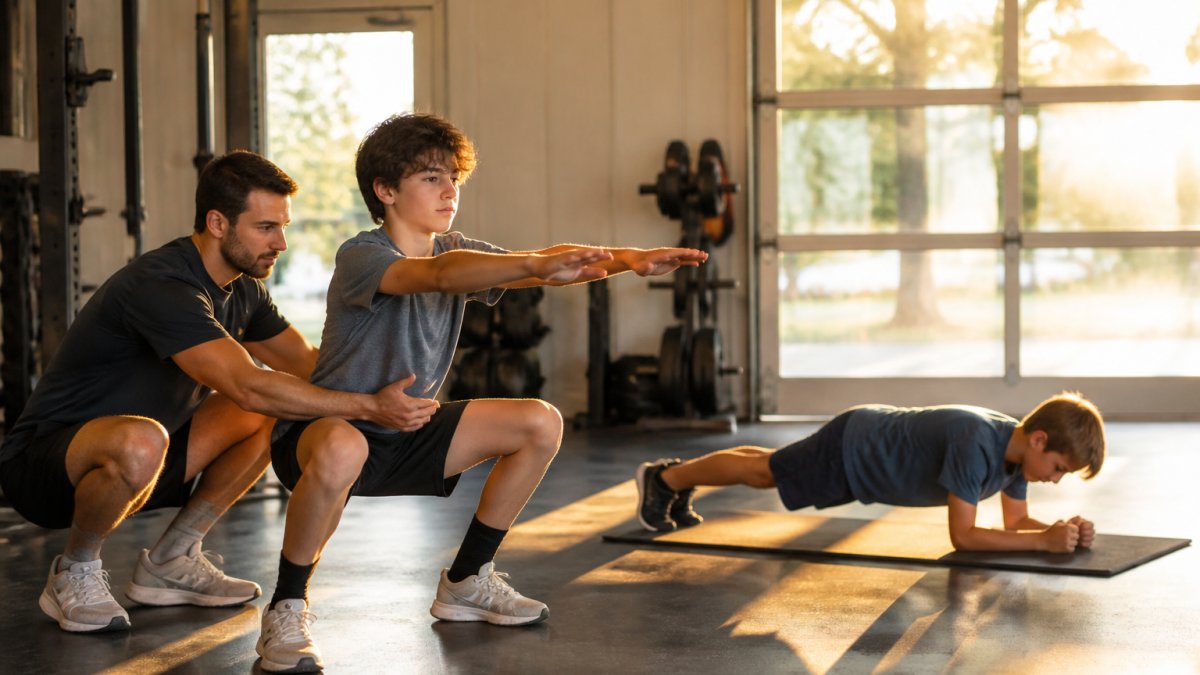
Resistance training for young athletes should build five patterns: squat, hinge, push, pull and carry. Every sport skill sits on top of these.
How to Coach Squat, Hinge, Push, Pull, and Carry
Squat. Feet shoulder-width, chest tall, sit down and back.
Hinge. Push hips back with a flat back, knees soft.
Push. Hands under shoulders, body in one line.
Pull. Shoulders down and back, pull with the elbows.
Carry. Walk tall with a weight at one side or both.
For a deeper look at how these patterns fit into the bigger picture, read our guide to sports performance training.
A Simple Youth Athlete Workout Plan for the First 12 Weeks
A youth athlete workout plan should start simple and stay simple for weeks. Repetition with good form beats fancy variety.
The 12-Week Phase Overview
| Phase | Weeks | Focus | Frequency | Session Length |
|---|---|---|---|---|
| Foundation | 1-4 | Bodyweight patterns and landing mechanics | 2 days/week | 30-35 minutes |
| Build | 5-8 | Light external resistance | 2-3 days/week | 35-45 minutes |
| Progress | 9-12 | Controlled load and single-leg work | 3 days/week | 40-45 minutes |
Each session follows the same skeleton: a 5-8 minute warm-up, 4-5 strength or movement stations, and a 3-5 minute landing or carry finisher. Keeping it identical lets coaching attention go to technique instead of logistics.
Foundation Phase (Weeks 1-4): Two Full-Body Days
Train on non-consecutive days, such as Tuesday and Thursday, so there is at least one full rest day between sessions.
Day A
- Bodyweight squat, 2 sets of 8-10 reps, 60 seconds rest
- Incline push-up (hands on a bench or box), 2 sets of 6-10 reps, 60 seconds rest
- Band row, 2 sets of 10-12 reps, 60 seconds rest
Day B
- Dowel hinge drill, 2 sets of 8 reps, 60 seconds rest
- Step-up onto a low box, 2 sets of 6 reps per leg, 60 seconds rest
- Band pull-apart, 2 sets of 12-15 reps, 45 seconds rest
Finish every Foundation session with 5 jump-and-stick repetitions: jump straight up, land softly with knees tracking over toes, and hold the landing for two seconds.
Build Phase (Weeks 5-8): Add Light Resistance
Add a third day only if the athlete recovers well and has no sport conflict. Otherwise stay at two days and add one set to each exercise.
Day A
- Goblet squat with a light dumbbell or kettlebell, 3 sets of 8-10 reps, 75 seconds rest
- Floor push-up or incline push-up, 3 sets of 6-10 reps, 75 seconds rest
- Dumbbell row, 3 sets of 8-10 reps per side, 75 seconds rest
Day B
- Kettlebell or dumbbell deadlift from the floor, 3 sets of 6-8 reps, 75 seconds rest
- Reverse lunge with bodyweight only, 2 sets of 6 reps per leg, 60 seconds rest
- Band row or chest-supported dumbbell row, 3 sets of 10-12 reps, 75 seconds rest
Day C (optional)
- Bodyweight squat, 2 sets of 12 reps
- Incline push-up, 2 sets of 10 reps
- Band pull-apart, 2 sets of 15 reps
Progress Phase (Weeks 9-12): Controlled Load and Single-Leg Work
Three days per week, still with at least one rest day between sessions. Load increases stay small, the smallest dumbbell or kettlebell available is usually enough.
Day A
- Goblet squat, 3 sets of 8-10 reps, 90 seconds rest
- Dumbbell bench or floor press (light), 3 sets of 8-10 reps, 90 seconds rest
- Dumbbell row, 3 sets of 8-10 reps per side, 90 seconds rest
Day B
- Dumbbell or kettlebell deadlift, 3 sets of 6-8 reps, 90 seconds rest
- Step-up onto a box, 3 sets of 6 reps per leg, 75 seconds rest
- Incline push-up, 3 sets of 8-12 reps, 75 seconds rest
Day C
- Bodyweight squat, 2 sets of 12 reps
- Band row, 3 sets of 12-15 reps
- Glute bridge, 2 sets of 10 reps
Exercise Substitutions for Limited Equipment
Most families do not own a full gym. These swaps keep the plan intact:
- No dumbbells: use a backpack loaded with books for goblet squats and carries, or a water jug for deadlifts.
- No bands: substitute towel rows (loop a towel around a sturdy post) or prone Y-T-W raises with light household objects.
- No box: use a sturdy step or a stack of firm cushions for step-ups and incline push-ups.
Progression Criteria Between Phases
Do not advance on the calendar alone. Move from Foundation to Build when the athlete completes every Foundation set with clean form, holds a 20-second front plank, and lands five consecutive jumps softly.
A common mistake is adding exercises every week. Resist that. Swap one exercise at a time, and only when form is solid.
Sets, Repetitions, and Progression Without Guesswork
Sets and reps for young athletes should stay conservative, with the last rep as clean as the first.
Starting Sets, Reps, and Rest by Phase
| Phase | Sets | Reps | Rest Between Sets | Load |
|---|---|---|---|---|
| Foundation | 2 | 8-12 | 45-60 seconds | Bodyweight or band only |
| Build | 2-3 | 8-10 | 60-75 seconds | Light dumbbell or kettlebell |
| Progress | 3 | 6-10 | 75-90 seconds | Small load jumps only |
Isolation and core work (planks, carries, dead bugs) follows a time-based rule instead: 15-30 seconds per set in Foundation, building to 20-40 seconds by Progress. Carries are measured in distance, 20 yards per side in Foundation, up to 30 yards by Progress.
The Progression Rule: Reps Before Load
Progression follows one simple rule: add reps before load. When an athlete hits the top of the rep range on every set with perfect technique, add a small amount of resistance and drop back to the bottom of the range.
A "small amount" means the smallest available jump, typically 2-5 pounds upper-body and 5-10 pounds lower-body. If the athlete cannot complete the bottom of the rep range with the new load and clean form, the jump was too big. Go back down and add reps instead.
Watch out: adding load because an athlete "looks strong" is the fastest way to break form. Earn the next weight with clean reps.
Progression Criteria You Can Actually Check
Use these pass/fail checks before advancing any exercise:
- Form check: the last rep looks the same as the first, no rounding, no knee collapse, no rushing.
- Tempo check: the athlete can lower for two seconds and pause for one second at the bottom on squats and deadlifts.
- Consistency check: the athlete completes the top of the rep range on two consecutive sessions, not just one good day.
If any check fails, repeat the same load and reps for another week. There is no penalty for repeating a week.
Measuring Progress Safely
Measuring progress safely means tracking movement quality, not just numbers. We look at squat depth, landing control, balance and how the athlete feels day to day. Strength gains follow those improvements.
Concrete measures to track:
- Movement quality: film a bodyweight squat from the side every four weeks and compare depth and back position.
- Consistent repetitions: count how many clean reps the athlete completes at a given load before form breaks, that number should rise over time.
- Balance: time a single-leg stand with eyes open; 20 seconds without wobble is a solid Foundation target.
Avoid unsupervised maximal lifting as a progress measure. A one-rep max tells you what an athlete can do once, not what they can do safely and repeatedly.
Two quality sessions a week beat four sloppy ones. Young athletes also play their sport, so strength work has to fit around practice. If a sport practice falls on a strength day, shorten the strength session rather than stacking both at full intensity.
Youth Speed and Conditioning That Supports Strength
Youth speed and conditioning should support strength work, not compete with it. Speed is a skill. Conditioning is a dose. Both need limits.
We keep speed work short and sharp:
- High-knee drills for 10-15 meters
- Ladder drills for footwork and coordination
- Short accelerations with full rest
Conditioning stays game-like and brief. Long, grinding runs build fatigue, not athletic development. For most team-sport athletes, sprint work and small-sided games cover it.
If you are weighing how much speed work your athlete actually needs, our article on whether speed and agility training is worth it for youth athletes breaks down the trade-offs.
Injury Prevention, Recovery, and Measuring Progress Safely
Injury prevention comes from good technique, sensible progression and enough recovery. No single exercise prevents injuries, the habits around training do most of the work.
Recovery basics we ask families to protect:
- Sleep on a consistent schedule (Sleep in Middle and High School Students | Healthy Schools)
- Protein at each meal
- One full rest day per week
Measuring progress safely means tracking movement quality, not just numbers.
If an athlete gets hurt, return-to-training should be gradual and guided. Our 7 steps to sports injury physical therapy for teens walks through that process.
Booking a Youth Strength Assessment at ProFormance Sports
A strength assessment can give you a clear starting point. At ProFormance Sports, our licensed physical therapists use InBody and Fit 3D scans to track change over time.
If you are deciding between one-on-one care and a group setting, read is one-on-one sports physical therapy worth it. And if you are comparing clinics, our guide to choosing the right sports physical therapy clinic covers what to ask.
Most young athletes train hard but never learn to move well under load.
ProFormance Sports offers personalized treatment plans with licensed physical therapists, InBody and Fit 3D tracking, and flexible scheduling options.
Frequently Asked Questions
Is strength training safe for young athletes?
Yes, when it is supervised and matched to the athlete's age and stage of development. Youth strength training programs that use bodyweight exercises, light resistance, and correct technique have a low injury rate. Most problems come from poor form, heavy loads, or no qualified coach watching. Start with foundational movement patterns like squat, hinge, push, pull, and carry, keep resistance low, and have a physical therapist or certified coach check technique before adding weight.
At what age can kids start strength training for teens and younger children?
Children as young as 7 or 8 can begin bodyweight strength training for young athletes, using exercises like push-ups, lunges, planks, and kettlebell deadlifts with very light load. Readiness matters more than a birthday: the athlete should follow instructions, control their body during a squat, and understand how to brace. Around puberty, when strength training for teens becomes more productive, free weights and structured progression can be added under supervision.
Can strength training stunt a child's growth?
There is no evidence that a well-supervised youth athlete workout plan stunts growth. Growth plates are sensitive to repeated heavy loading and poor technique, which is why qualified coaches keep resistance low, prioritize landing mechanics and proper form, and avoid max-effort lifts. The bigger risk is injury from unsupervised training or too much sport-specific volume. A physical therapist can screen movement and flag issues before they become injuries.
How often should young athletes strength train, and what belongs in the program?
Two to three sessions per week on non-consecutive days is enough for most young athletes, with youth speed and conditioning work kept separate or folded into the same session. A balanced program includes the five movement patterns, sets of 1 to 3 with 8 to 15 repetitions at low resistance, and progressions based on clean technique rather than added weight. Recovery, sleep, and nutrition matter as much as the exercises, and a qualified coach should review the plan every few weeks.